Local research highlights how AI and digital tools are reshaping social work in Singapore
Date: 26 Mar 2026
Findings presented at SWAPS 2026 show how technology can strengthen practice, reduce workload, and support better outcomes, while preserving the human touch.
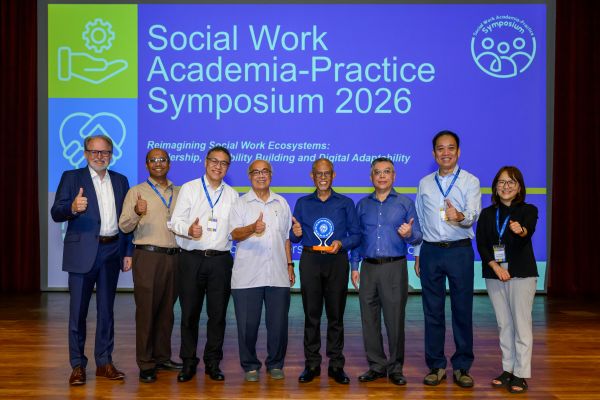
Mr Masagos Zulkifli, Minister for Social and Family Development, attended SWAPS 2026 as the Guest-of-Honour. The symposium was co-organised by Allkin Singapore and Singapore University of Social Sciences, and featured speakers from Singapore and abroad.
THURSDAY, 26 MARCH 2026 – New local research presented at the Social Work Academia-Practice Symposium (SWAPS) 2026 has shed light on how digital tools and artificial intelligence can strengthen social work practice in Singapore, from easing administrative burdens to enhancing training and service delivery, while preserving the human connection at the heart of the profession.
More than 200 academics, practitioners, and thought leaders gathered at the biennial symposium, co-organised by Allkin Singapore and Singapore University of Social Sciences (SUSS), to explore how social work can adapt as digital innovation continues to reshape industries and service delivery worldwide.
Mr Masagos Zulkifli, Minister for Social and Family Development, attended SWAPS 2026 as the Guest-of-Honour. The symposium examined the theme “Reimagining Social Work Ecosystems” through the lenses of digital adaptability, capability building, and transformative leadership, discussing how social work practice must evolve to future-proof the profession amidst a rapidly changing world.
Technology as an enabler, not a replacement
At the Social Service Summit 2025, Minister Masagos emphasised that while the use of data, technology, and AI can allow us to provide more personalised and targeted care, the human touch and empathy in how we deliver our services must remain evident.
Across the social service sector in Singapore, new technological tools are increasingly being adopted to ease social workers’ workload, streamline documentation, and reduce their risk of burnout. Yet, much uncertainty remains about the effectiveness, long-term costs, and ethical issues of these tools. Technological advancements carry both potential benefits and risks for the industry, which practitioners must familiarise themselves with without compromising the trust and empathy that underpin effective social work.
SWAPS 2026 addressed this critical gap by surfacing evidence-based, locally-grounded research that identify existing needs, illuminate best practices, and ignite innovation. Among over 25 research presentations by representatives from social service agencies, institutes of higher learning, and healthcare institutions, topics included:
- An AI-powered role-playing tool to train medical social workers in managing complex client interactions
- Anonymous digital platforms designed as relational entry points for youth help-seeking in community mental health practice
- Effectiveness of AI-assisted documentation in social work
- Virtual facilitation capabilities for online family violence interventions
The symposium also featured insights from international perspectives, including a keynote and workshop by Professor Eunjung Lee from University of Toronto on using simulation-based learning as an innovative tool for social workers to assess and build their professional competence in a safe environment.
Bridging academia and practice to shape real-world change
Since its inception in 2013, SWAPS, co-organised by Singapore University of Social Sciences (SUSS) and Allkin Singapore, has been distinctive in marrying academia and practice – bringing together educators, researchers, and practitioners to address emerging challenges in the social service sector. By connecting insights from academia with real-world practice, the symposium aims to translate research into practical approaches that can strengthen support for communities.
Mr Fareez Fahmy, CEO of Allkin Singapore, said: “SWAPS 2026 highlights that the future of social work is not about choosing between technology and human-centredness. Instead, it is about reimagining social work ecosystems where both reinforce each other through continual learning and collaboration.“
Professor Robbie Goh, Provost of Singapore University of Social Sciences, said: “Social work remains deeply human at its core, but the sector is evolving rapidly as new technologies reshape how services are delivered. At SUSS, we see this reflected in our work with community partners and in how we prepare future social workers through education and research. Platforms like SWAPS allow academia and practice to come together to explore how innovation can strengthen the sector while keeping people at the heart of social work.”
For more details, click here to visit the SWAPS 2026 website.
For media enquiries, please contact:
Ms Sarah Lim
Executive, Strategic Communications & Partnerships
Allkin Singapore
Email: [email protected]
Contact no.: +65 9098 9076
Ms Nur Aziemah Binte Aziz Public Relations Manager
Singapore University of Social Sciences
Email: [email protected]
Contact no.: +65 6240 8846
About Allkin Singapore
Founded in 1978, Allkin Singapore (formerly known as AMKFSC Community Services) is a community-centric social service agency that believes everyone can create positive change, including those who seek help.
Each year, the organisation journeys with over 20,000 vulnerable individuals, including children, youth, families, seniors, and persons facing mental health challenges.
Beyond immediate support, Allkin unlocks opportunities for them to grow their potential, strengthen support networks, and shape their communities – helping them overcome challenges, build a brighter future, and inspire others to do the same.
Discover more about Allkin Singapore at http://allkin.org.sg
About Singapore University of Social Sciences
At SUSS, we have a singular vision to be a university that inspires learning for life and impacts lives, regardless of age, background or life path. Our university is a vibrant tapestry of ages and experiences. From recent JC and polytechnic graduates to seasoned professionals, parents seeking new horizons and individuals redefining their careers in their golden years—our diverse community comes together for one common goal: to empower themselves with an education that impacts lives and society.
We offer more than 110 undergraduate and graduate programmes, available in full- and part-time study modes which are flexible, modular and interdisciplinary, catering to both fresh school leavers and adult learners. SUSS also offers a broad range of continuing education and training modular courses for the professional skills upgrading of Singapore's workforce.
Our programmes and courses are offered by our six schools:
- S R Nathan School of Human Development
- School of Business
- School of Humanities & Behavioural Sciences
- School of Law
- School of Science & Technology
- School of Social Work & Social Development
Since becoming an Autonomous University in 2017, over 21,000 graduates have experienced our unique brand of education. More than 19,000 students are currently pursuing their full- and part-time studies with us.
The Institute for Adult Learning (IAL), as part of SUSS, leads in the field of research on adult and workplace learning and training of adult educators to build capabilities of the training and adult education sector in Singapore and beyond.
For more information about SUSS, please visit www.suss.edu.sg.