More Support for Graduates in Seeking Employment as Employment Outcomes Dip
Date: 5 Mar 2026
Joint Autonomous Universities Graduate Employment Survey 2025
More Support for Graduates in Seeking Employment as Employment Outcomes Dip
1. Singapore, 5 March 2026 - The 2025 Joint Autonomous Universities Graduate Employment Survey (JAUGES)1 found that 92.2% of recent graduates were in the labour force2 (i.e. working or looking for a job), an increase from 90.7% the previous year. Amidst continuing economic uncertainty and weaker hiring demand compared to previous years, 88.9% of graduates in the labour force secured employment (i.e. they were employed, had accepted a job offer or were starting a business venture) within six months of completing their final examinations (see Table 1), a decline from 91.2% in 2024. The median gross monthly salary among fresh graduates in full-time permanent employment held steady at $4,500 in 2025.
Table 1: Employment indicators from 2023 to 2025
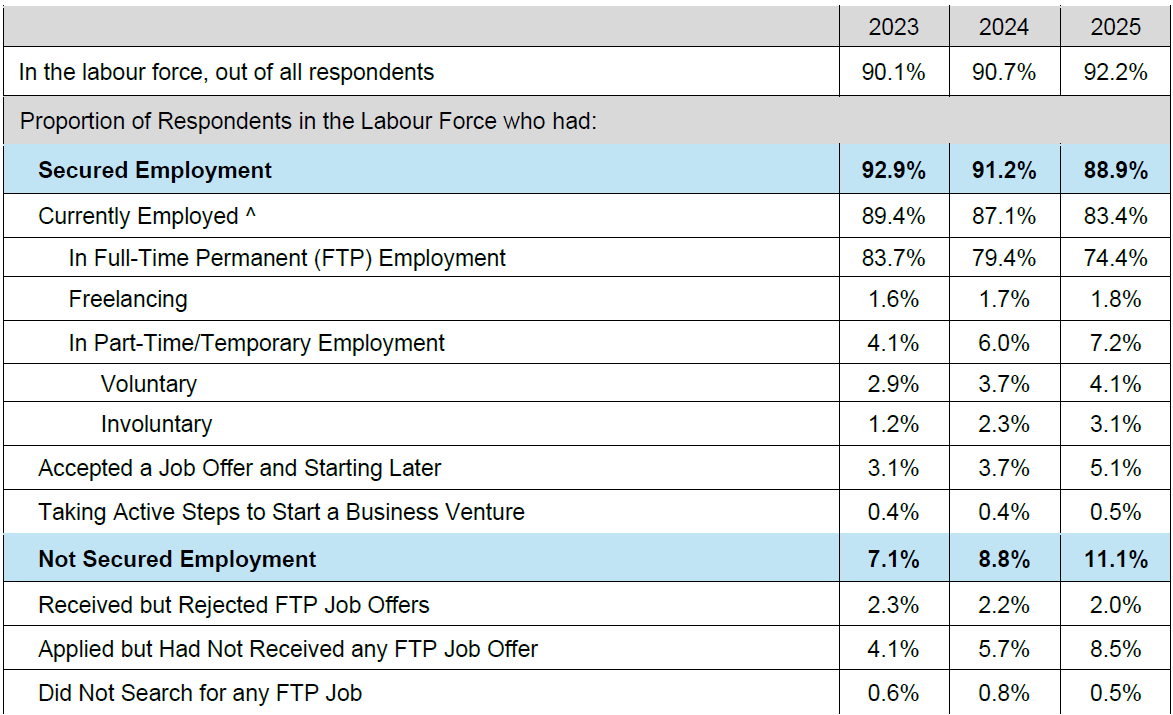
2. The percentages may not add up due to rounding. The definitions for the employment indicators can be found at Annex A.
2. In recent years, the number of job vacancies has moderated from the post-pandemic peak, driven by reduced churn and slower hiring. This reflects a more cautious hiring sentiment amid broader economic uncertainty and geopolitical developments. While there continues to be entry-level job opportunities, some outward-oriented sectors, such as Information & Communications, saw more subdued hiring compared to previous years.
Better graduate employment outcomes by the one-year mark
3. The GES is based on a snapshot of graduate employment outcomes about six months after their final examination, i.e. as at 1 November 2025. Based on administrative wage records of past cohorts, the graduate employment outcomes generally continue to improve beyond the 6-month mark, as more graduates subsequently secure jobs. As an illustration, the GES employment rate for the 2024 cohort was 2%-pts lower than the 2023 cohort, at 87% in 2024 as compared to 89% in 2023. By the 12-month mark, the proportion of the 2024 cohort who had wage records was comparable to that of the 2023 cohort (both at 95% in 2024 and 2023). The remaining 5% includes graduates who were not employed, pursuing further studies, or working overseas, as well as self-employed or freelance workers whose income are not reflected in wage records.
4. Based on MOM’s labour market data, there continues to be employment opportunities for fresh graduates. About four in ten entry-level vacancies are in growth sectors such as Financial & Insurance Services, and Professional Services, and in occupations such as financial compliance officers, risk analysts and auditors. Graduates continued to seize these opportunities beyond the 6-month mark captured by the GES.
Support for graduates looking for jobs
5. The AUs have stepped up their efforts to support students and fresh graduates, including proactively engaging those who may require additional support to provide personalised assistance, and regularly disseminating available job opportunities to them. Graduates who require support in their job search process may approach their AUs for dedicated career coaching and participate in career fairs, recruitment events, workshops, and talks organised by their AUs.
6. Graduates may also tap on career resources, guidance, and job search services from Workforce Singapore (WSG) and NTUC’s Employment and Employability Institute (e2i). These can help them better understand the range of jobs available, and make more informed choices that are aligned with their strengths and interests.
7. Additionally, the GRaduate Industry Traineeships (GRIT) and GRIT@Gov Programmes launched by the Ministry of Manpower (MOM), WSG, and the Public Service Division in October 2025, support fresh graduates with no prior working experience to gain hands-on industry-relevant experience and skills, and strengthen their employability by preparing them for successful transition into full-time employment. There are still vacancies available for graduates from the 2025 cohort experiencing difficulty in securing employment. As announced at MOM’s Committee of Supply 2026, graduates from the 2026 cohort will also be able to apply for GRIT and GRIT@Gov. More vacancies will be made available depending on economic and labour market conditions.
1 The JAUGES is conducted by the six Autonomous Universities (NUS, NTU, SMU, SUTD, SIT, SUSS) in November to collect information on the employment status of graduates, around six months after their final examination. This year, 14,397 graduates took part in the survey, accounting for a response rate of 73.7%.
2 The remaining 7.8% were not in the labour force and could consist of those pursuing further studies or preparing to commence further studies, and those not looking for a job for various reasons, including taking a break after graduation.
^ This term corresponds to the “overall employment rate” in previous JAUGES press releases.
For media enquiries, please contact:
NTU Media Contact
Foo Jie Ying
Assistant Director,
Corporate Communications Office
Nanyang Technological University
Email: [email protected]
NUS Media Contact
Valerie Yeo
Deputy Director,
Office of University Communications
National University of Singapore
Email: [email protected]
SIT Media Contact
Nur Helna Allisa
Senior Assistant Manager,
Singapore Institute of Technology
Email: [email protected]
SMU Media Contact
Jean Lim
Senior Assistant Director, Corporate Communications
Office of Corporate Communications and Marketing
Singapore Management University
Email: [email protected]
SUSS Media Contact
Nur Aziemah Binte Aziz
Public Relations Manager,
Communications & Marketing
Singapore University of Social Sciences
Email: [email protected]
SUTD Media Contact
Melissa Koh
Manager (Public Relations),
Office of Marketing and Communications
Singapore University of
Technology and Design
Email: [email protected]
ANNEX A: DEFINITION OF EMPLOYMENT INDICATORS
Employment refers to graduates working in full-time permanent, part-time, temporary employment and freelancing. The employment rate is the number of employed graduates, as a proportion of graduates in the labour force (i.e. those who were working or not working but actively looking and available for work).
Secured Employment refers to graduates who are in employment, have accepted a job offer and will start later, or taking active steps to start a business venture.
Full-time Permanent Employment refers to employment of at least 35 hours a week and where the employment is not temporary. It includes those on contracts of one year or more.
Freelancing refers to those who operate their own business without employing any paid worker in the conduct of their business or trade.
Part-time Employment refers to employment of less than 35 hours a week.
Temporary Employment refers to casual, interim or seasonal employment, including those on contracts of less than one year.
Involuntary part-time/temporary employment refers to those who indicated that they were in part-time/temporary employment after they were unable to obtain a full-time permanent job offer.
Voluntary part-time/temporary employment refers to those who indicated that they were in part-time/temporary employment as they were pursuing/ preparing to commence further studies or taking active steps to start a business venture, due to personal choice and other reasons.
Gross Monthly Salary comprises basic salary, fixed allowances, overtime pay, commissions and other regular cash payments, before deduction of the employee’s CPF contributions and personal income contributions, bonuses, stock options, other lump sum payments and payments-in-kind are excluded.