
MOE subsidies for the SUSS School of Law Juris Doctor (JD) Programme
Currently students of the JD programme who have received government subsidies or sponsorship for undergraduate programmes will not be eligible for the MOE Tuition Grant. In simple terms, a Singaporean graduate with a bachelor’s degree from an autonomous university, e.g., NUS or NTU, would not be entitled to any subsidy from the government for the JD programme. The total unsubsidised cost of a JD degree for a student below the age of forty at 2025 is $165,888, while a subsidised JD degree would cost $38,880.
From July 2026 onwards, students of the JD programme, both Singapore citizens and permanent residents, who have not previously received any government subsidy or sponsorship for a postgraduate programme locally or abroad, will be eligible for subsidies from the Ministry of Education.
This means a Singaporean with an undergraduate degree from an autonomous university will now be eligible for subsidy from the government as long as that person has never received subsidy for postgraduate study. For instance, a social worker with a bachelor’s degree in social work from the National University of Singapore can now receive subsidy for the JD programme.
Existing students who are receiving the Tuition Grant will continue in their current scheme, i.e. they will not be affected by this change.
Existing JD students who are not receiving the Tuition Grant, and qualify for MOE subsidies, will receive subsidies for the remainder of their programme. The subsidy will only apply for courses taken from July 2026. No subsidy will be provided for courses taken prior to that date.
If you have any queries regarding the JD subsidy, you may contact our Graduate Programmes department at [email protected].
Eligibility
Who is eligible for the MOE subsidies?
Singapore Citizen (SC) and Singapore Permanent Resident (PR) students enrolled in the JD programme will be eligible for MOE subsidies from July 2026. These students should not have previously received MOE subsidy or government sponsorship for a postgraduate programme, whether in Singapore or overseas.
I have already obtained a first degree. Can I still qualify for the subsidy?
Those who already have a first degree may qualify if (1) above is satisfied.
E.g. If you have previously received MOE Tuition Grant for your undergraduate degree offered by autonomous universities in Singapore (i.e. SUSS/NUS/NTU/SMU/SUTD/SIT) and have not received MOE subsidy or government sponsorship for a postgraduate programme, you will be eligible for the MOE subsidies for the JD programme.
Do I have to be of a minimum age to qualify for the subsidy?
No, you do not have to be of a minimum age to qualify for the subsidy, as long as you meet the eligibility criteria for the subsidy.
Subsidy Cover and Quantum
How much course fee do I have to pay to the university if I am eligible for the subsidy?
Students can refer to the subsidised fees payable at Law Programmes Tuition Fee & Subsidy as a reference. Note that all fees are reviewed annually and may be revised. The University reserves the right to adjust the fees without prior notice.
Course fees will be cohort based, i.e. the course fee is fixed upon the year’s fees when you are enrolled. Eligible students will be subsidised up to the minimum credit units required for graduation, within the candidature period of 6 years, i.e. 150 credit units. Students will be billed every semester based on the number of courses they have registered for.
What does the subsidy cover?
Students eligible for the subsidy will pay the subsidised fees, capped at the programme’s maximum candidature of 6 years or upon fully utilising the subsidy (i.e. 150 credit units), whichever is earlier.
The subsidy does not cover:
- Resit fee
- Extra courses taken beyond the requirements for the programme
- Auxiliary charges like administrative fees (e.g., transfer of programme, challenge exam fee, exam appeal, etc.), overseas travel expenses, etc.
- Any penalty charges (e.g., late fee payment)
- Any other miscellaneous fees.
Different courses have different course fees. Does the subsidy apply to all courses?
The subsidy applies to all courses within the JD programme curriculum.
Is there a cut-off date to fully utilise the subsidy? Or is a student eligible for the subsidy as long as he/she is pursuing the degree within the programme’s maximum candidature?
Students will not be eligible for the subsidy beyond their programme’s maximum candidature of 6 years or upon fully utilising the subsidy (i.e. 150 credit units), whichever is earlier.
I enrolled in the JD programme before the July 2026 semester. Will I be eligible for the subsidy?
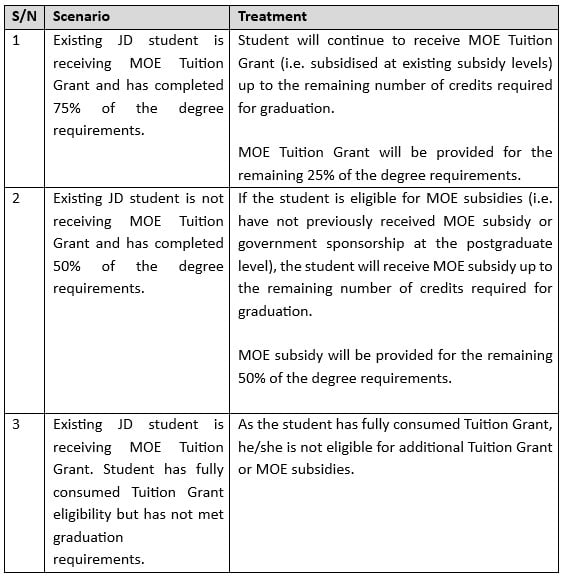
Eligibility for MOE subsidies will depend on a student's current subsidy status and progress towards programme completion. The table below outlines the subsidy treatment for existing JD students from the July 2026 semester onwards.
Subsidy Treatments for Existing JD Students from July 2026 semester onwards
Changes in Eligibility Status
Is the eligibility for the subsidy considered only at the point of admission?
Yes, eligibility for the subsidy is considered at the point of admission.
I am currently a Singapore Permanent Resident. If I were to obtain the Singapore citizenship mid-way during my studies, will I be eligible for a higher amount of subsidy?
Yes, but the subsidy would only be effective for course fees payable from the next academic semester onwards. No retrospective claims will be allowed.
Financial Assistance
Will I be eligible for government bursaries?
Existing Singaporean students who received MOE Tuition Grant during their course of study, will continue be eligible for government bursaries.
New Singaporean students who are admitted from July 2026 semester will not be eligible for government bursaries.
Number of Credit Units (CUs) Subsidised
What is the number of registered CUs which can be subsidised?
For the JD programme, students will be subsidised for a maximum of 150 registered CUs over the 6-year maximum candidature period.
Transfer/Re-admission University Students
If I have previously completed a postgraduate programme at another autonomous university and had received government subsidy for that degree, can I still qualify for the subsidy for another postgraduate programme at SUSS?
No, students who had previously received government subsidy for another postgraduate programme are not eligible for the subsidy for a second postgraduate programme at SUSS.
If I have received partial tuition subsidy previously (e.g., enrolled but withdrew from one of the autonomous universities without having obtained postgraduate degree), am I still eligible for the subsidy if I enrol with SUSS now?
If you are transferring from a subsidised postgraduate programme from another autonomous university to another subsidised postgraduate programme at SUSS, your subsidy eligibility for the new programme at SUSS will take into account the subsidy you have previously received and be pro-rated accordingly, subject to satisfying the criteria listed in (1).
Changes to Student's Programme of Studies
If I apply for a transfer from a subsidised postgraduate programme within SUSS, can I claim subsidy for the JD programme?
The JD programme does not allow students to transfer in from another programme within SUSS. You would need to make a new application for the JD programme. If you are successfully enrolled into the JD programme, the subsidy for JD programme will take into account the subsidy you have previously received and be pro-rated accordingly.
Obligations – Bond, Non-completion of Programme
Do I have to repay the subsidy or serve any bond?
No, there is no need to repay the subsidy or serve any bond. Existing PR students on the MOE Tuition Grant (Scheme) will still be required to serve TG obligations.
If I accept the subsidy and subsequently withdraw from the JD programme, do I have to repay the subsidy to MOE or SUSS?
No, you do not have to repay the subsidy to MOE or SUSS.
Note that students who have withdrawn from the JD programme will not be allowed to re-enrol in the JD programme. You can, however, choose to re-enrol in other postgraduate programmes offered by SUSS.
Others
If I am sponsored by my company, can I choose not to receive the subsidy?
Yes, students who do not wish to receive the subsidy can inform SUSS in writing.
If I am enrolled before the July 2026 semester, can I defer my JD studies to July 2026 in order to utilise the MOE subsidy?
Yes, you can. If you are eligible, you will receive the MOE subsidy from July 2026 onwards. However, any costs associated with the deferment will be borne by you. You should also keep in mind that the programme’s maximum candidature is 6 years and the deferment period will be considered as part of your candidature period. Students who are considering this route are strongly encouraged to contact their assigned Academic Advisors for advice.
Information is accurate as of 15 July 2025.
Curriculum changes affecting LLB and JD programmes
Starting in 2026, the academic year for the SUSS Law programmes - Juris Doctor (JD) and Bachelor of Laws (LLB) will begin in July semester, replacing the current January start. Alongside this scheduling change, significant curriculum updates will be introduced.
Students in both JD and LLB programmes will take new and revised courses. Some of these changes include:
- LAW202 Critical Thinking, Legal Writing and Legal Interpretation, which will consolidate two existing courses;
- LAW251 Introduction to Financial Reporting for Lawyers, will become a compulsory subject;
- A new course in civil law fundamentals, LAW329 Principles of Chinese Civil Law, will be introduced;
- The existing legal clerkship course will be revised and replaced with LAW498 Legal Clerkship Programme.
For LLB students starting in July 2026, a new pathway will be made available. Students will have a choice between completing 30 credit units (cu) of elective courses or 30 cu in a specific minor programme.
Transition measures will be in place to support current students as they move into the revised curriculum.
These updates aim to improve academic flexibility and broaden professional competencies across our law programmes.