SBIZ Finance Research Workshops
In November, the Finance Research Interest Group (RIG) brought together faculty members with shared interests in finance and related interdisciplinary domains. Its primary mission is to foster collaborative research that combines theoretical rigor with practical and societal relevance. The group aligns with SUSS’s mission by promoting applied research for social good.
AI and Finance
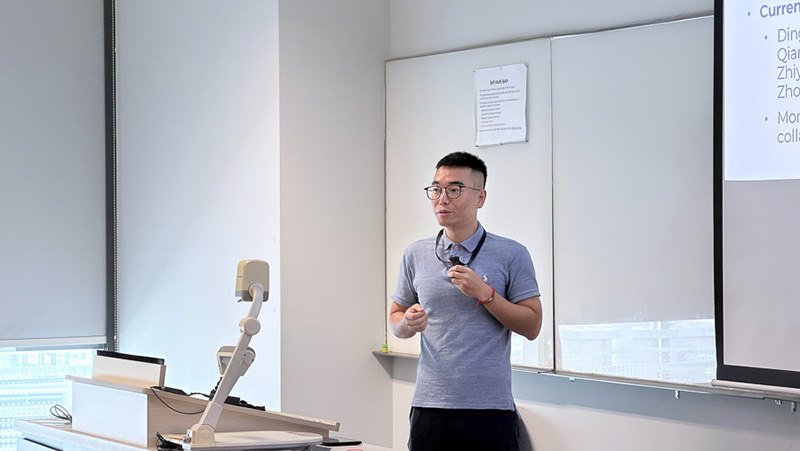
Dr. Ding Qinxu shared his research on AI and finance. His work focuses on generative AI applications, NLP-based market intelligence, and explainable AI, aligning with MAS guidelines. He raised important questions about the necessity of finance-specific large language models (LLMs), the design of real-world testing environments, and improving the transparency of AI-driven decisions.
Sustainable Finance and Behavioural Insights
Dr. Qian Shuoge presented his studies on sustainable finance, behavioural asset pricing, and the Chinese economy. His research examines corporate carbon footprints, emission reporting practices, and the role of AI in decarbonization. In the behavioural finance domain, he integrates gambler, overconfidence, and affect investor biases into asset pricing models. His work also explores poverty alleviation and market reforms in China, as well as green debt structures and hidden global ownership.
Corporate Finance and Gender Studies
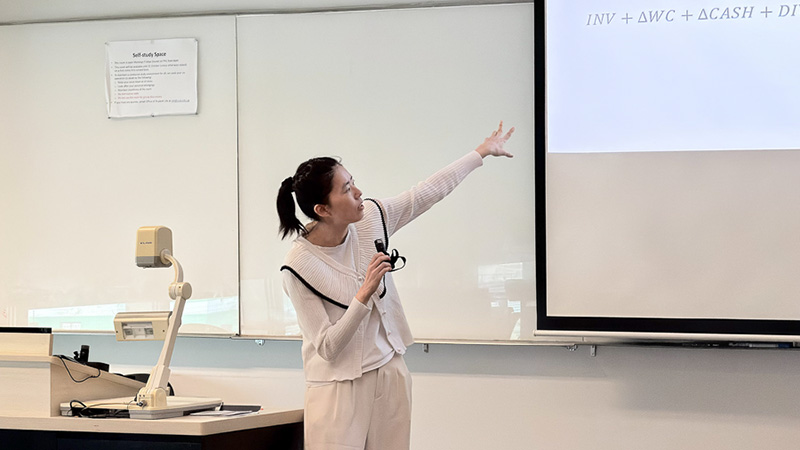
Dr. Carmen Shih Chia Mei discussed her research on corporate cash flow policy and gender diversity in corporate decision-making. She highlighted the declining sensitivity of investments to internal cash flow and emphasized the importance of integrated financial decision frameworks. Her findings show that female executives tend to be more risk-averse, while greater board gender diversity enhances oversight and ethical standards. She suggested that future research explore gender effects on mergers and acquisitions, capital structure, dividend policies, and ESG initiatives.
Quantitative and AI-Driven Financial Models
Dr. Wang Zhiyuan presented his work on multi-objective optimisation (MOO), multi-criteria decision-making (MCDM), and AI-based frameworks. He applies fuzzy logic, reinforcement learning, and machine learning techniques to ESG evaluation and financial optimisation, contributing to more data-driven and adaptive financial decision systems.
Finance for Social Good
Dr. Xia Chongwu shared his research agenda centred on achieving social good through financial research. His work explores how financial practices can promote positive societal outcomes, focusing on rank-and-file employees, business ethics, and ESG. He proposed future research directions, including the use of AI to improve ESG ratings, textual analysis of online reviews to understand consumer-driven ESG initiatives, and an examination of common ownership’s role in social welfare.
Macroeconometrics, Energy Economics, and ESG
Dr. Zhou Shihao discussed his research spanning inflation dynamics, energy market efficiency, ESG methodologies, and pandemic economics. His findings indicate no trade-off between saving lives and supporting the economy, underscoring how effective health and economic policies can reinforce each other. He also contributes to policy discussions on sustainability and trade economics.
The Finance RIG sharing session showcased diverse yet complementary expertise across finance, behavioural economics, sustainability, artificial intelligence, and econometrics. Collectively, the members are addressing critical questions—how finance can advance social good, how AI is transforming decision-making, and how sustainability reshapes corporate behaviour. The workshop underscored a unifying goal: to leverage interdisciplinary collaboration for impactful, socially relevant financial research. With expertise ranging from quantitative modelling to ethical analysis, the sharing served as a dynamic platform for research collaboration within the School of Business.