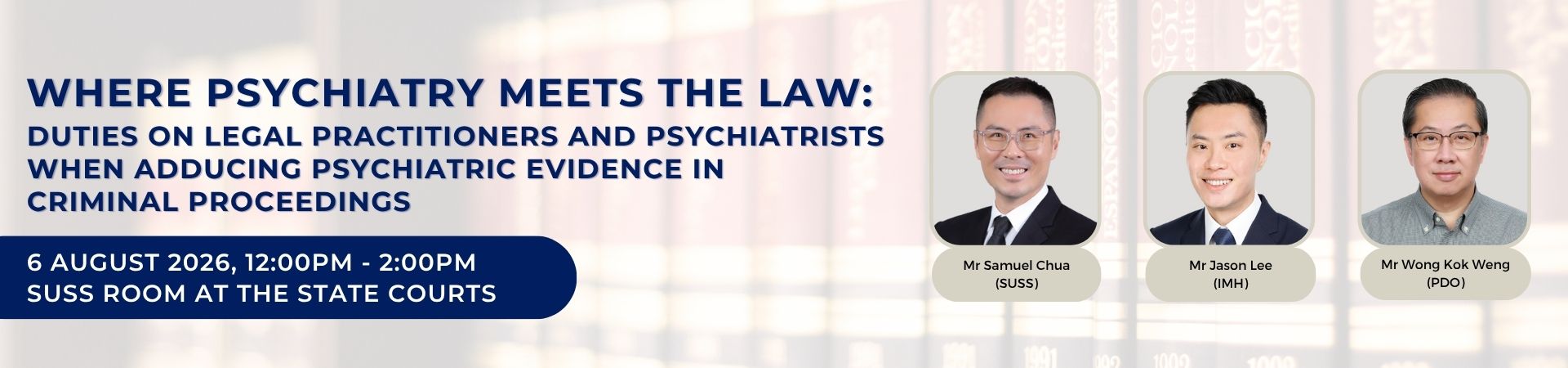
Where Psychiatry Meets the Law
Date: 6 Aug 2026
Time: 12.00PM to 02.00PM
Venue: SUSS Room at the State Courts
Event Type: Seminars
School/Department: School of Law
Register Now!Overview
Psychiatric evidence frequently features in criminal proceedings to assist the Court in assessing the existence, nature and severity of an accused person's mental condition, and the extent to which it impacts his legal responsibility for the alleged offence.
Judges, prosecutors and defence counsel must necessarily rely on the expert opinion of psychiatrists to assess the relevance of the accused person's mental condition to his culpability in committing the offence, his susceptibility to treatment and his prognosis. On the other hand, psychiatrists must familiarise themselves with the legal parameters within which psychiatric evidence can be adduced in Court, in order for their forensic assessment and evidence (in the form of expert reports and oral testimony) to be accepted by, and be helpful to, the Court. By carrying out their respective roles in the criminal proceedings, judges, prosecutors, defence counsel and psychiatrists ensure that justice is done vis-à-vis not only the public interest, but also the victim and the accused, and that the punishment fits both the offence and the offender.
In the context of the Criminal Procedure (Expert Opinion) Rules 2025 which came into operation on 31 December 2025, and the legal principles that the High Court and Court of Appeal have laid down in recent cases, this seminar will discuss the professional and ethical duties on prosecutors, defence counsel and psychiatrists when adducing psychiatric evidence in criminal proceedings, so that the psychiatric assessment is accurate, comprehensive and objective, and the psychiatric evidence is cogent, defensible and helpful to the Court.
Issues that will be covered in the seminar include:
- How is psychiatry relevant in criminal proceedings?
- What is the juridical status of psychiatric evidence in criminal proceedings?
- What is the governing statutory framework for adducing psychiatric evidence in Court?
- What is the role of a legal practitioner in instructing a psychiatrist for forensic psychiatric assessment?
- What is the role of a psychiatrist and what are some best practices when conducting forensic psychiatric assessments?
- What should a forensic psychiatric report contain?
- What is the role of a legal practitioner in adducing psychiatric evidence in Court?
- What is the role of the Court?
- How should psychiatric evidence be adduced in criminal proceedings?
Seminar Information
2 Public CPD Points (inclusive of 1 MEC Point)
Practice Area: Crime
Training Level: General
Course Fee: $98.10
Registration Deadline: 30 July 2026
Event ID: EV26000134
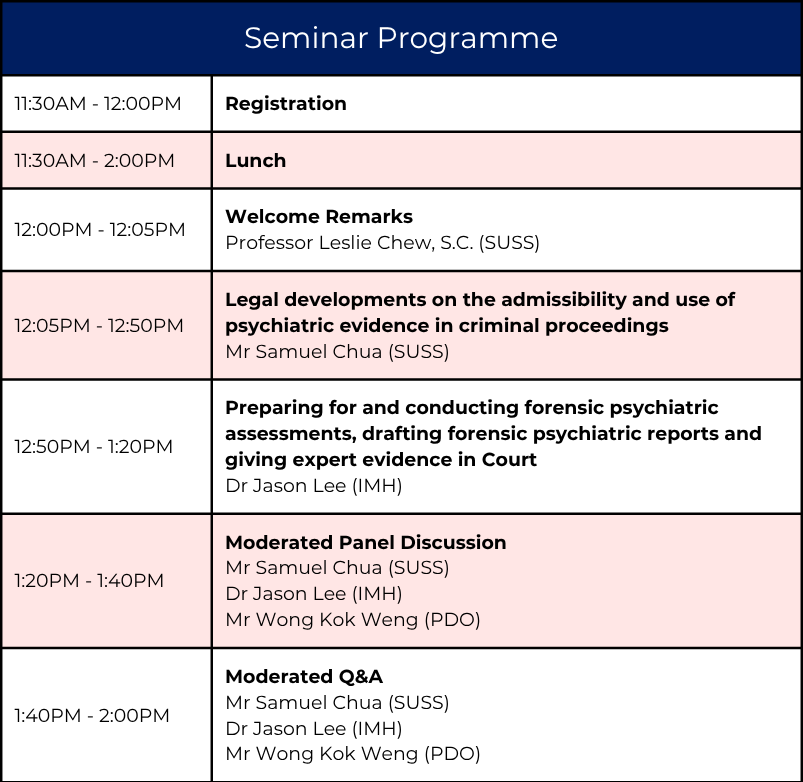
Programme
Speakers
Mr Samuel Chua (SUSS)
Mr Samuel Chua is a Senior Lecturer in the Singapore University of Social Sciences' School of Law where he teaches Criminal law, evidence and procedure, and Mediation Advocacy. He is concurrently a Consultant with M/s Tito Isaac & Co LLP and is an accredited mediator with the Singapore Mediation Centre and the Singapore International Mediation Institute.
He obtained his Bachelor of Laws from the National University of Singapore in 2006 and his Master of Laws (Judicial Studies) from the Singapore Management University in 2021.
Prior to joining academia, Mr Chua was in the Singapore Legal Service for about 18 years. He spent 8 years as a Deputy Public Prosecutor in the Attorney-General’s Chambers and specialised in assessing and prosecuting capital murder and drug cases in the High Court. Over the next 7 years, he served as a District Judge in the State Courts, where he adjudicated criminal cases and community law-related cases, conducted Coroner’s Inquiries and assisted to establish the Community Disputes Resolution Tribunals, apart from other initiatives. For his contributions to the public service, Mr Chua was awarded the Public Administration Medal (Bronze) during the 2018 National Day Awards.
After completing his LLM, Samuel served as Deputy Director (Prosecution & Regulatory Enforcement) in the Ministry of Manpower's Legal Services Division, where he assessed and made the prosecutorial decisions for criminal cases under MOM’s purview, prosecuted cases at trial in the State Courts, argued Magistrate's Appeals and Criminal Motions in the High Court and exercised the administrative functions of Deputy Commissioner for Foreign Manpower, Assistant Commissioner (Work Injury Compensation) and authorised officer under the Employment of Foreign Manpower Act 1990, Work Injury Compensation Act 2019 and Employment Act 1968 respectively.
Dr Jason Lee (IMH)
Dr Jason Lee is Chief and Senior Consultant of the Department of Forensic Psychiatry at the Institute of Mental Health.
He obtained his Membership of the Royal College of Psychiatrists in 2012 and went on to train as a clinical fellow at the University of British Columbia, Canada, qualifying him as a Subspecialist Affiliate in Forensic Psychiatry at the Royal College of Physicians of Canada in 2020.
He has played a key role in advancing forensic psychiatric services in Singapore, including pre-trial assessments, correctional mental health care, and inter-agency collaborations.
He currently also serves as Vice-Chairman of the Section of Forensic Psychiatry at the College of Psychiatrists, contributing to professional training and practice development in the field.
In pursuit of his interest in business management, he has completed and holds an MBA from Alliance Manchester Business School.
Panellist
Mr Wong Kok Weng (PDO)
Mr Wong Kok Weng was appointed the Chief Public Defender in December 2022. He oversees the Public Defender’s Office, which provides criminal defence aid for persons with limited means facing non-capital criminal charges.
Mr Wong served as a Magistrate at the then-Subordinate Courts from 1988 to 1991, and as a legal counsel at the Ministry of Defence from 1991 to 2000. From 2000 to 2022, he was a Deputy Public Prosecutor (DPP) in the Crime Division of the Attorney-General’s Chambers. As a Senior Director, he led a team of DPPs prosecuting diverse criminal offences.
In 2013, Mr Wong also chaired an inter-agency committee that looked into providing support for accused persons with mental disorders or intellectual disabilities during the criminal investigation process. The committee’s findings led to the introduction of the Appropriate Adult Scheme in 2015. This scheme was extended to young suspects in 2017. Mr Wong continues to chair the committee overseeing both schemes. Mr Wong also sits as a member of the Sentencing Advisory Panel and the Inclusive Justice Taskforce.
Mr Wong obtained the Public Administration Medal for Bronze in 1999 and for Silver in 2024 and the Long Service Award for 35 years of service in 2021 and for 40 years of service in 2026.
SILE Attendance Policy
Participants who wish to obtain CPD Points are reminded that they must comply strictly with the Attendance Policy set out in the CPD Guidelines. For this activity, you must sign in on arrival and sign out at the conclusion in the manner required by the organiser, and not be absent from the entire activity for more than fifteen minutes. Participants who do not comply with the Attendance Policy will not be able to obtain CPD Points for attending the activity. Please refer to http://www.sileCPDcentre.sg for more information.
.png?sfvrsn=3ff28c3b_3)