
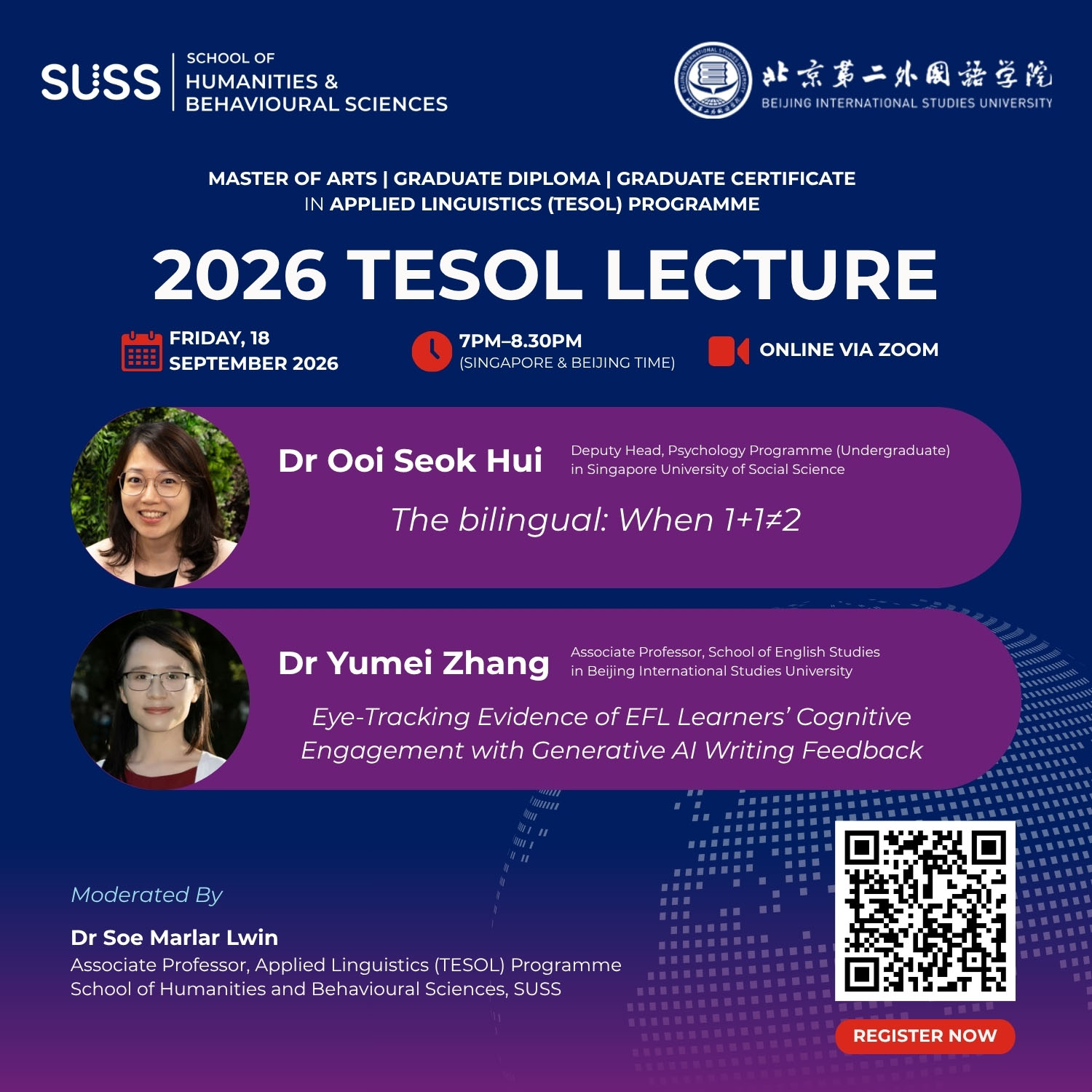
SUSS TESOL Lecture 2026
Date: 18 Sep 2026
Time: 07.00PM to 08.30PM
Venue: Online via Zoom
Event Type: Seminars
School/Department: School of Humanities and Behavioural Sciences, Graduate Studies
Register NowJointly presented by School of Humanities & Behavioural Sciences, SUSS & School of English Studies, Beijing International Studies University
Featured Presentations
The Bilingual: When 1+1≠2
This talk explores how the experience of being bilingual can alter the way we perceive and process information, beyond simply language domains. We review what the general evidence says regarding the view that the bilingual is not “two monolinguals in one person”, as posited by François Grosjean, and consider the implications this could have as teachers of second language learners.
| Dr Ooi Seok Hui is the deputy head of the Psychology undergraduate programme at the Singapore University of Social Sciences. She received her PhD in Psychology from the University of Edinburgh, where she spent her time investigating cognitive control in bilingual speakers from varying language backgrounds. She is curious about how being bilingual influences the way people think and process information. |
Eye-Tracking Evidence of EFL Learners' Cognitive Engagement with Generative AI Writing Feedback
Generative AI (GenAI) feedback effectively boosts writing performance, yet its cognitive processing mechanisms remain underexplored from a cognitive neuroscience perspective. This mixed-methods eye-tracking study addresses three questions about cognitive load: attentional distribution across content, linguistic and logical feedback, and cognitive predictors of feedback uptake and revision quality. Thirty-four non-English majors completed writing, eye-tracking, revision and stimulated recall tasks. Analyses integrated fixation metrics, revision score gains and thematic coding of verbal reports. Results show nonlinear, iterative feedback processing. Content and linguistic feedback triggers heavier cognitive load than logical feedback. Learners’ attention shifts temporally: indifferent at first, biased toward content mid-process, and focused on language later. Though eye-tracking indices cannot predict uptake, late linguistic fixations forecast linguistic score growth, and reprocessing time correlates with total score gains. Uptake also relies on non-cognitive factors including feedback recognition, revisability judgment and writing self-efficacy. Long gaze does not equal effective revision, offering empirical support for optimized GenAI writing feedback design aligned with learners’ cognition.
| Dr Yumei Zhang is an Associate Professor at School of English Studies, Beijing International Studies University. She holds a Doctorate in Applied Linguistics. Her primary research interests cover second language acquisition, foreign language teaching and assessment. She has published numerous academic papers in SSCI and CSSCI core journals, authored two monographs and co-authored one scholarly book. She presides over two provincial/ministerial-level research and teaching research projects, and acts as a core team member in multiple national and provincial/ministerial research projects concerning foreign language education and language assessment. |
Session Chair
Dr Soe Marlar Lwin
Associate Professor, Applied Linguistics (TESOL) Programme, School of Humanities and Behavioural Sciences, SUSS
Stay Connected with SUSS Graduate Studies
Follow us on LinkedIn for the latest updates on programmes, student experiences, and global opportunities.