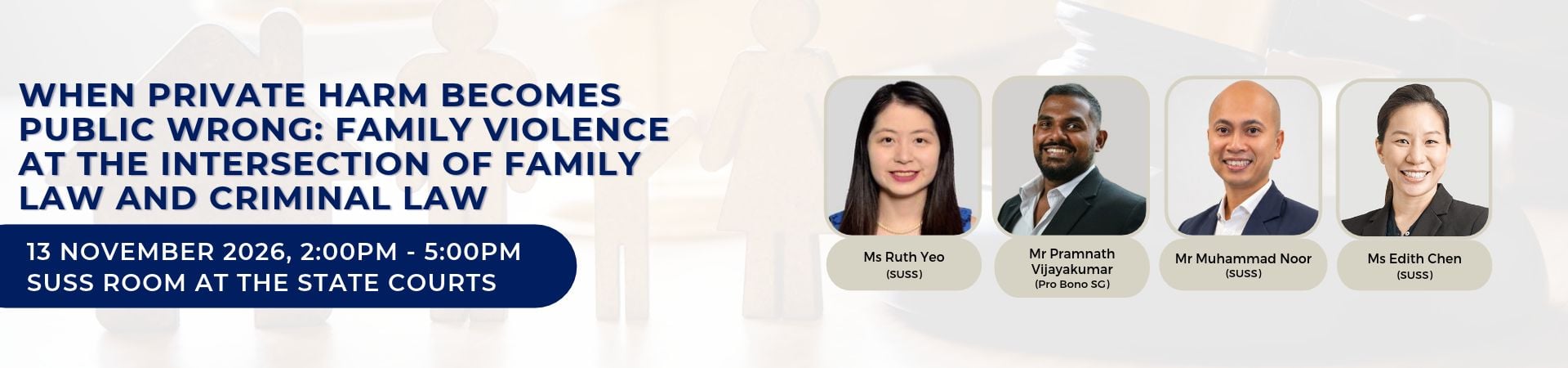
When Private Harm Becomes Public Wrong
Date: 13 Nov 2026
Time: 02.00PM to 05.00PM
Venue: SUSS Room at the State Courts
Event Type: Seminars
School/Department: School of Law
Register Now!Overview
Family violence sits astride two bodies of Singapore law designed with very different objects in mind: the family law regime under Part 7 of the Women’s Charter 1961 and the Children and Young Persons Act 1993, which is protective, forward-looking and largely victim-initiated; and the criminal law, which is retrospective, punitive and state-initiated. The same act may engage both regimes at once, yet in practice the two systems often operate in parallel rather than in concert. This seminar, designed for legal practitioners, judges, academics and social service professionals, reframes family violence as a genuinely hybrid family law and criminal law problem that demands a coordinated, cross-disciplinary response.
The seminar is anchored in the death of four-year-old Megan Khung in February 2020 (PP v Foo Li Ping and anor matter [2025] SGHC 60) and the findings of the independent Review Panel, which identified lapses in inter-agency communication, coordination and adherence to established procedures. It is also set against a backdrop of significant reform, including the Women’s Charter (Family Violence and Other Matters) (Amendment) Act 2023, the enhanced Penal Code 1871 penalty framework for offences against vulnerable persons and persons in intimate or close relationships, the recommendations of the Taskforce on Family Violence and the continuing development of therapeutic justice in the Family Justice Courts.
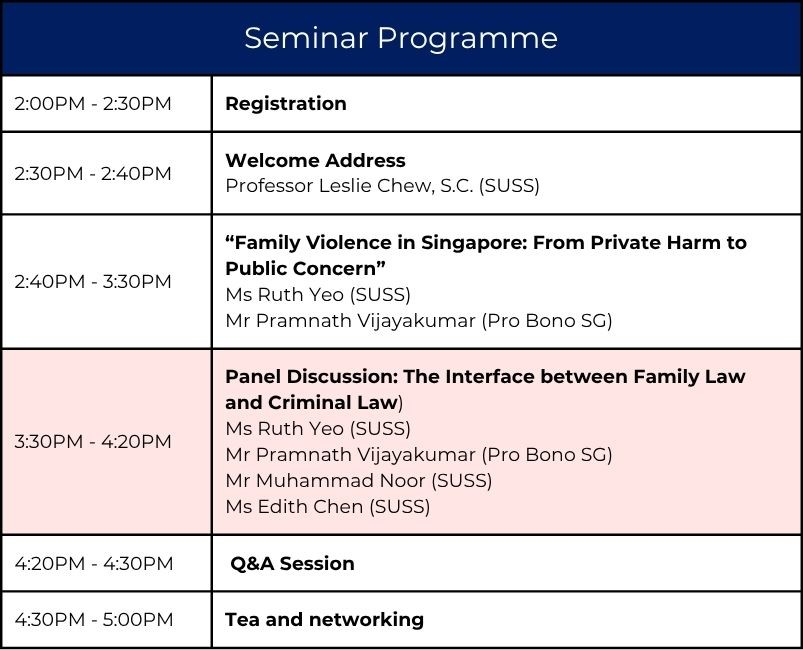
The seminar will begin feature a joint presentation, “Family Violence in Singapore: From Private Harm to Public Concern”, and a panel discussion on the interface between family law and criminal law, bringing together perspectives from academia, practitioners and social work practice.
The speakers and panellists will examine the following topics:
(i) The escalation continuum: family violence as a single behavioural trajectory viewed through two legal lenses, and where the legal system should place its “tripwires” for detection and escalation.
(ii) The evolution of Singapore’s understanding of family violence – the new definition, framework and focus under the Women’s Charter 1961 – alongside the common offences arising from domestic settings, police intervention and prosecutorial considerations.
(iii) Parallel proceedings and the question of who “owns” a case that straddles both systems, including inter-agency information flows, the use of family proceedings material in criminal proceedings (and vice versa), differing standards of proof and the risk of inconsistent findings on the same facts.
(iv) Competing interests and difficult questions: victim autonomy versus state intervention, the relevance of family violence allegations in divorce and custody disputes, and the scope and limits of mandatory reporting and professional confidentiality.
(v) Emerging challenges and future directions, including coercive control, technology-facilitated abuse and the case for integrated justice responses.
Seminar Information
2 Public CPD Points (Inclusive of 1 MEC Point)
Practice Area: Family
Training Level: General
Course Fee: $98.10
Registration Deadline: 6 November 2026
Event ID: CETW033-260001
Programme
Speakers
Ms Ruth Yeo (SUSS)
Ruth Yeo is a Senior Lecturer at the School of Law, Singapore University of Social Sciences. She teaches Family Law, Constitutional Law and Tort Law. She has published refereed journal articles on selected areas of family and trusts law, corporate law and tort law both internationally and in Singapore.
Ruth obtained a Bachelor of Laws (First Class Honours) from the National University of Singapore in 2010. She was awarded the Law Society Book Prize in her third year, in addition to being placed on the Dean’s List every year. She obtained a Master of Laws from New York University in 2010. Ruth joined the Singapore Legal Service in 2010 and began her career as a Justices’ Law Clerk. She was then appointed as an Assistant Registrar of the Supreme Court of Singapore. Subsequently, she served as a State Counsel in the Civil Division, Attorney-General’s Chambers, where she advised and represented MSF in various matters relating to child protection. She also served as a Deputy Public Prosecutor in the Crime Division, Attorney-General’s Chambers.
Mr Pramnath Vijayakumar (Pro Bono SG)
Pramnath is Deputy Director of Community Legal Services and Head of Legal Operations at Pro Bono SG, Singapore's largest coordinated pro bono legal services organisation. A practising Advocate and Solicitor, he conducts criminal matters at every level of the Singapore courts, and co-leads the teams delivering pro bono legal help across criminal, family and community matters.
This vantage point places Pramnath at the practical intersection of the criminal and family justice systems; he sees how family violence can surface as a criminal matter, and what becomes of the victims and accused persons, often unrepresented or vulnerable, whose cases move between the two.
Across both roles, Pramnath's interest lies in how the criminal and family justice systems coordinate in practice, where the handover between them holds, where it falls short, and what that means for the people caught in between.
Panellists
Mr Muhammad Noor Latasa Bin Abdul Latiff (SUSS)
Muhammad Noor Latasa Bin Abdul Latiff is a Lecturer with the School of Social Work and Social Development at the Singapore University of Social Sciences (SUSS). Prior to joining SUSS, he was a Principal Medical Social Worker at KK Women's and Children's Hospital (KKH), where he worked closely with individuals and families experiencing crisis, family violence, child protection concerns, trauma, mental health challenges, and complex healthcare needs across the lifespan.
With close to 15 years of frontline and leadership experience in healthcare social work, Noor has specialised in crisis intervention, risk assessment, safeguarding practices, and multi-agency collaboration. He has been actively involved in training and workforce development, designing and delivering programmes for social workers, healthcare professionals, students, and community practitioners on family violence, child protection, trauma-informed practice, suicide awareness, grief, and compassionate communication. He brings extensive frontline, supervisory and educator experience to discussions on family violence, drawing on his work with vulnerable populations, families and professionals across health and community settings.
Ms Edith Chen (SUSS)
Edith is a Senior Lecturer at the School of Law, Singapore University of Social Sciences (SUSS), and is part of the team at SUSS which teaches the Family Law courses. The Family Law courses taught at SUSS comprise the study of both substantive and procedural family law using an integrated approach and adopt as a core concept the philosophy of Therapeutic Justice.
Edith graduated from the National University of Singapore in 2009 where she was awarded the LexisNexis Family Law Prize in Academic Year 2007/2008. Admitted to the Singapore Bar in 2010, she joined Tan Rajah & Cheah and practised in family law litigation among other areas of law. Today, Edith continues to maintain a niche practice in family law as a Consultant with the firm. Edith is also an accredited mediator with the Singapore International Mediation Institute and an Associate mediator under the Law Society Mediation Scheme Panel.
SILE Attendance Policy
Participants who wish to obtain CPD Points are reminded that they must comply strictly with the Attendance Policy set out in the CPD Guidelines. For this activity, you must sign in on arrival and sign out at the conclusion in the manner required by the organiser, and not be absent from the entire activity for more than fifteen minutes. Participants who do not comply with the Attendance Policy will not be able to obtain CPD Points for attending the activity. Please refer to https://www.sileCPDcentre.sg for more information.
.png?sfvrsn=3ff28c3b_3)