The Power of Play: Singapore Early Childhood Education Chinese Symposium 2021
Date: 30 Aug 2021
News Type:Event Highlights
School/Department: -
“Bright Beginnings: The Power of Play in Early Childhood Education” – the theme of this year’s Singapore Early Childhood Education Chinese Symposium is into its fifth year and took place virtually on the 7th of August 2021.
Jointly organised by SUSS’ Centre for Chinese Studies and S R Nathan School of Human Development, the event was kicked off by two heavyweight keynote speakers, Professor Hua Aihua, Director of the Department of Preschool Education at East China Normal University, and Ms Cheng Xueqin, creator and designer of the Anji Play philosophy and approach, who are prominent figures in the early childhood education sector. The event attracted an audience of over 800 people!
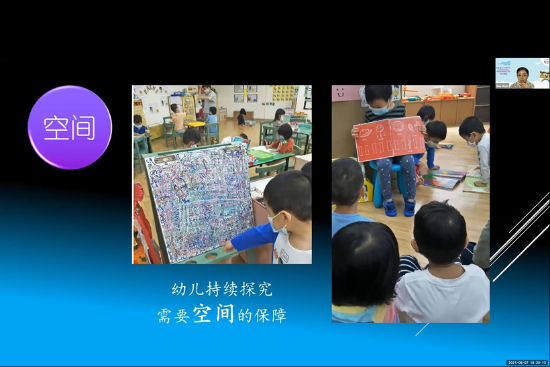 The Power of Play at work in the Early Childhood Symposium
Professor Cheong Hee Kiat, President of SUSS, shared in his opening remarks that play is something that is largely universal and is a great way to help our children relate well to one another, irrespective of race, language, culture and background, especially in multi-racial, multi-cultural Singapore. He added that SUSS offers a continuing education (CET) module titled “Play-based Early Education in Anji”, and the university plans to incorporate it into its Bachelor of Early Childhood Education with Minor and Master of Early Childhood Education degrees as an elective subject in the days to come.
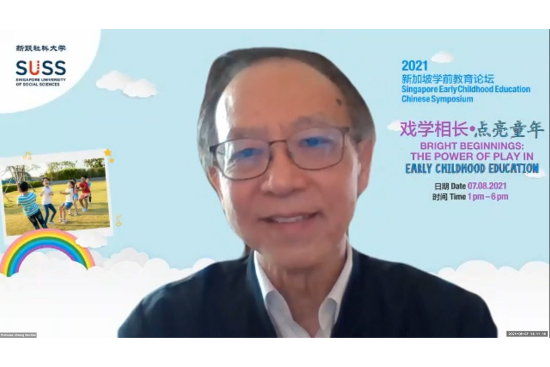
SUSS President, Prof Cheong Hee Kiat, sharing his opening remarks with the audience.
So what is Anji play? Anji Play is the result of a reflective journey that witnessed a change in early childhood education from No Play to False Play (teacher-directed) to True Play (child-directed), explained Ms Cheng.
Based on the five principles of Anji Play, namely, Love, Risk, Engagement, Joy and Reflection, the perspectives of early childhood education evolved into creating the right conditions for True Play and True Learning, yet not setting any rigid rules for play. Preschoolers not only get to use their imagination and thinking ability in “free play”, they also derive immense enjoyment from it.
Furthermore, according to Prof Hua, we need to recognise that children see the world differently, and the more teachers let go, the better children perform. Teachers can then observe how children display their aptitudes and provide the appropriate support.
Prof Hua also explained the use of existing resources to create conducive conditions for play and to achieve educational goals by reducing the class duration and increasing “free play” activities.
In addition, both speakers addressed a common concern among the preschool teachers in the audience; that is, how to engage parents and garner their support for the Anji Play approach. Over the Q&A session, the speakers also shared success stories from overseas kindergartens that had adopted the Anji Play approach.
Over the symposium, four local preschool teachers also discussed how play is incorporated in their teaching and the significance of play-based learning. Their presentations, especially the challenges they had faced, resonated with many of the attendees who were preschool teachers themselves.
“The concept of Anji Play has increased my awareness of play in early childhood education”, “The different ideas shared by the local teachers are helpful and relevant to practitioners”, and “I hope to learn more about the Anji Play approach and to visit their kindergartens” – these were some of the positive and heartwarming feedback received from the participants who had attended this year’s symposium.
We hope to host our preschool educators again and looking forward to raising our industry’s collective knowledge in early childhood education to the next level!
Read more on the event coverage: https://www.8world.com/singapore/suss-new-course-1551466