Sustainable Asia Conference 2025: Advancing Research with Real-World Impact
Date: 29 Oct 2025
News Type:Event Highlights
School/Department: Advancement Office
The inaugural Sustainable Asia Conference (SAC2025), convened by the Singapore University of Social Sciences (SUSS) and hosted by the School of Business, brought together more than 270 academics, industry leaders and policymakers united by a shared purpose: to advance Sustainability in Asia through rigorous research and practical collaboration.

Industry leaders share insights on the evolving role of chief sustainability officers in shaping corporate strategy at the Conference
(From left: Ms Clara Kwan from School of Business, Dr Pang Chin Hong from Mapletree Investments, Mr Marcus LeMaster from Schneider Electric, David Fogarty from United Nations Global Compact Network Singapore and Mr Helge Muenkel from DBS Bank, moderated by Ms Tan Lee Cheng from School of Business.)
Held on 29 and 30 October and co-organised by the School of Business and the university's Sustainability Committee, the conference showcased how academia and industry can collaborate to address emerging challenges and drive meaningful change. Through a new dual academic and industry co-review model, presenters received feedback that was both research-grounded and operationally relevant. Ideas were challenged, refined and strengthened in ways that bridged scholarly insight with real-world application.
Building a Resilient Asia Through Innovation
Asia is home to more than 60 per cent of the world's population and remains at the epicentre of climate risk. Rapid urbanisation and industrialisation continue to place pressure on ecosystems, infrastructure and communities. Reflecting its theme, "Building a Resilient Asia: Innovating through Infrastructure, People, and Finance," SAC2025 served as a platform to explore how the region can respond to these pressures through practical, interdisciplinary solutions.
Over the course of two days, presenters shared data-driven research on climate resilience, sustainable infrastructure, human capital development and emerging financial mechanisms. Discussions explored how innovation in governance and financing can foster inclusive growth, as well as how sectors across Asia can transition toward more equitable and sustainable models.
Academic and Industry Partnerships in Action
The conference emphasised the importance of partnerships in achieving sustainable outcomes. Supported by Mapletree, SAC2025 demonstrated how collaboration between private sector organisations and academic institutions can generate insights that inform both policy and practice.
Among the industry voices on stage was Dr Pang Chin Hong (pictured above, second from left), Head of Group Sustainability at Mapletree Investments, who spoke about the built environment sector's evolving approach to Sustainability. He highlighted how organisations are working to balance stakeholder needs with long-term growth strategies and environmental responsibility.
Dr Pang shared, "Sustainability is a shared journey, where partnerships between academia and industry are the catalyst for real progress. By combining research depth with practical experience, we create an ecosystem where ideas evolve into impactful solutions for people and the planet."

Dr Tan Eng Joo, Head for Graduate Programmes, presents the closing remarks.
Echoing this sentiment, Dr Tan Eng Joo, Head of Graduate Programmes in Sustainability Management at SUSS, noted that the dual review model reflects the university's commitment to applied research. "We have long spoken about applied research. This conference actually puts it into practice."
Strengthening SUSS Leadership in Applied Sustainability Research
Through this initiative, SUSS reaffirmed its mission to champion applied research that serves society and addresses real-world needs. The conference's success highlighted the value of donor-supported platforms that enable knowledge exchange, spark innovation, and nurture a new generation of scholars and practitioners dedicated to shaping a more sustainable Asia.
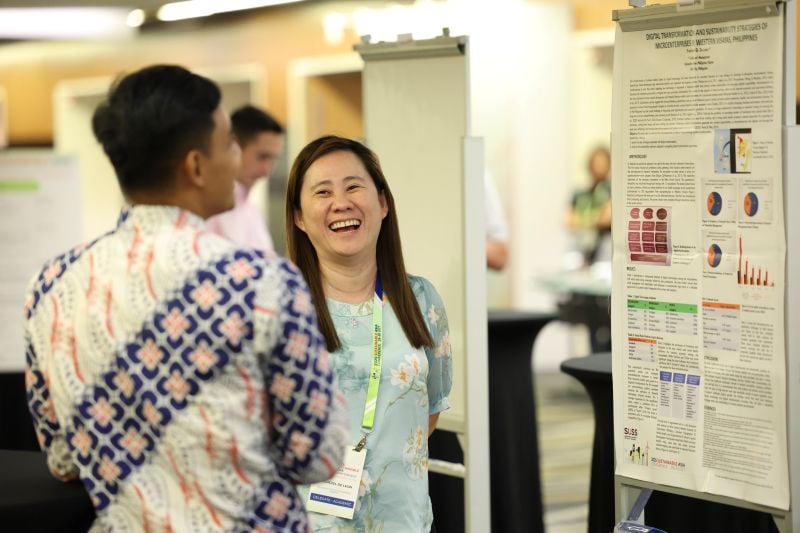
Delegates viewing abstract submissions on display during the Conference.
SAC2025 not only showcased thought leadership in Sustainability but also illustrated how academia and industry can transform shared purpose into meaningful progress. As the region continues to confront climate and development challenges, the conversations and collaborations seeded at this conference will inform solutions that benefit communities across Asia.