Redefining Performance and Rewards in the AI Era: Insights from Dr Fermin Diez
Date: 16 Jan 2026
News Type:Event Highlights
School/Department: S R Nathan School of Human Development
On 16 January 2026, the S R Nathan School of Human Development (NSHD) launched its inaugural SUSS Human Capital Insights Series.The public webinar, “The Future of Work and Pay: How Technology and AI are Redefining Performance and Rewards”, featured Dr. Fermin Diez, a renowned human capital expert and former Deputy CEO of the National Council of Social Service (NCSS), Singapore.
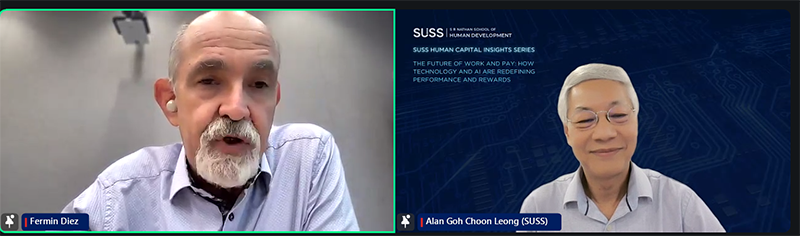
The proceedings commenced with a warm welcome from Mr Sanjaiswaran Kamala Kannan, President of the SUSS HRM Interest Group and moderated by Mr Alan Goh, Senior Lecturer at SUSS specialising in compensation and benefits. The event reached a diverse group of HR practitioners, academics, students, and policymakers from both corporate and social sectors.
The central theme was the urgent need for a paradigm shift in how organisations value their workforce. Dr Diez argued that traditional compensation models—many of which have remained unchanged for over 50 years—are becoming obsolete in a landscape dominated by rapid technological change, shifting demographics, and the rise of agile and borderless operating models.
Failure of traditional “carrot and stick” systems
A key insight shared by Dr Diez was traditional “pay-for-performance” systems are often ineffective and needs to be overhauled. He noted that interventions intended to impact productivity—including training, goal setting, and team structures—financial incentives were among the least predictable.
"If I want to run a race, I will need to be stressed. If I want to give my best and really get the best performance, I will need to be stressed. There is no such thing as no stress with higher performance." — Dr. Fermin Diez
However, many organisations continue to rely on “pay-for-performance” systems that often result in employee dissatisfaction during the annual performance management cycle. Dr Diez challenged the long-held belief that “everyone is motivated by money”. Instead, employees increasingly prefer a guaranteed higher base salary over a potentially larger package tied to uncertain performance targets and share prices. For policymakers, this suggests that fostering financial stability through higher base pay may be a more effective driver of intrinsic motivation and long-term retention than traditional bonus-heavy structures.
From administration to personalisation
Dr Diez discussed how Artificial Intelligence (AI) is shifting the rewards function from manual administration to strategic, personalised service. He discussed how AI is shifting the rewards function from manual administration to strategic, personalised service. He pointed out the inertia in the current HR landscape: “But when you look at compensation... we haven't changed. It's still the same. In fact, the majority of companies are still doing compensation in Excel worksheets. Nothing has changed”.
AI models are already capable of handling job analysis, descriptions, and evaluations, which allows them to replace the manual work currently done in Excel, such as building salary structures and merit increases according to Dr Diez. For policymakers, this technological shift necessitates a move away from governing static job grades toward frameworks that support data-driven equity and individual choice. Policymakers must focus on ensuring that these AI-driven personalised models are applied fairly across diverse demographics to prevent new forms of systemic bias, while also maintaining a standard of transparency in the reward process to build trust.
Dr Diez cautioned that AI cannot replace the “human” in Human Resources. While AI chatbots can answer employee questions faster by interpreting company manuals, a real-life HR person is essential when AI cannot understand the nuanced emotional and personal needs of the workforce.
Navigating agile ecosystems and skills-based pay
The modern business environment is increasingly defined by agile and borderless ecosystems that rely on a highly diverse talent pool. Dr Diez highlighted that up to 33% of staff may soon be gig or contract workers rather than traditional full-time employees. This shift makes paying for a static “job grade” obsolete. Instead, organisations must transition toward skills-based pay, rewarding employees for the acquisition and mastery of new competencies rather than years of service. Echoing this call for transformation, moderator Alan Goh concurred that in the future of work, pay models can no longer remain static. Instead, they must become as agile as the skills and technology that drive the business.
“In the future of work, it is clear that our pay models can no longer be static. They must be as agile as the skills and technology that drive the business.” — Alan Goh, Singapore University of Social Sciences
For policymakers and HR leaders, this combined shift requires frameworks that ensure pay equity throughout the entire talent spectrum. Implementing mechanisms like skill-based allowances and radical transparency in pay policies is critical to avoid friction between different worker types. By linking base salary increments to competency growth, organisations can maintain a competitive edge while ensuring that rewards systems are suited to all employee types, needs, and motivation profiles.
Practical implementation
The Q&A segment addressed the “how-to” of these radical shifts, particularly regarding multi-generational workforces. When asked how rewards can reach employees with vastly different views on pay, Dr Diez noted that this is precisely where personalised pay succeeds. By giving employees the autonomy to choose their own compensation mix—be it based on age, life stage, or job function—organisations allow individuals to decide their own risk and rewards. This transition does not happen overnight; it often begins with pilot programmes that build cultural buy-in.
Furthermore, participants raised concerns about the potential for bias in AI-driven rewards. Dr Diez reassured the audience that while algorithms can standardise evaluations, human oversight remains non-negotiable. This ensures that data does not inadvertently penalise certain demographics or overlook the “unquantifiable” contributions of employees. Moderator Alan Goh concluded by observing that smaller organisations and the social sector are often best positioned to pilot these agile models, as they are not constrained by the rigid legacy systems often found in large multinationals. Ultimately, the webinar highlighted that while technology provides the tools for change, the success of future reward systems depends on a human-centric approach to leadership and governance.
Watch the Replay: You can watch the full recording of "The Future of Work and Pay: How Technology and AI are Redefining Performance and Rewards" at https://www.youtube.com/watch?v=gl2VyBRnHgw
About the SUSS Human Resource Management Programme
The SUSS Human Capital Insights series provides thought leadership on the key trends and strategic imperatives reshaping Asia's human capital landscape. The series is organised by the SUSS Human Resource Management Programme, which offers undergraduate and postgraduate degrees, from the Bachelor of Human Resource Management—Singapore's first and only full-time bachelor degree in HRM offered by an Autonomous University—to the Master of Human Capital Management. Our programmes are designed to equip HR professionals with the applied industry knowledge and strategic acumen needed to lead, innovate, and thrive in the future economy.
Visit us at: www.suss.edu.sg/academics/schools-college/nshd/human-resource-management-cluster