Addressing HR Malpractice in the Modern Workplace: Insights from Ms Low Peck Kem
Date: 29 May 2026
News Type:Event Highlights
School/Department: S R Nathan School of Human Development
On 29 May 2026, the S. R. Nathan School of Human Development (NSHD) hosted the second edition of the SUSS Human Capital Insights Series. This series provides specialised, deep-dive analysis of Asia's most pressing human capital issues. The webinar, titled "The Ethics of Excellence: Addressing HR Malpractice in the Modern Workplace", featured keynote speaker Ms Low Peck Kem, Chief HR Officer and Advisor for Workforce Development at Singapore’s Public Service Division (PSD). Moderated by Dr Charissa Tan, the session examined how HR professionals can reclaim their role as ethical stewards in an increasingly AI-driven workplace.
Ms Low Peck Kem is a distinguished leader in human capital management, the Chief HR Officer and Advisor for Workforce Development at Singapore’s Public Service Division. Throughout her distinguished career, she has championed workforce transformation across both global private enterprises and the public sector. Her leadership extends internationally as the past President of the Asia Pacific Federation of Human Resources Management (APFHRM) and through her work with the World Federation of People Management Associations (WFPMA).
At the core of the discussion was the growing tension between efficiency and human judgement. As organisations adopt AI-enabled tools in recruitment, performance evaluation, and workforce planning, administrative convenience risks becoming the default mode of decision-making. Ms Low cited a striking study by researchers from the University of Maryland, NUS, and Ohio State, in which 2,245 human-written resumes were rewritten by seven leading AI models and then evaluated by those same models. Every model chose its own rewrite over 90% of the time — even when human evaluators judged the originals to be clearer and more effective. More troublingly, the AIs also preferred themselves over other AI models roughly 70% of the time, revealing a structural “self-preferencing” bias that organisations relying on automated screening may be entirely unaware of.
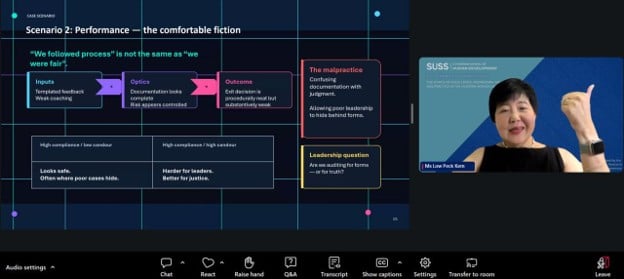
Similarly, in retrenchment practices, the desire for speed and cost efficiency can lead HR professionals to default to process adherence without exercising critical judgement. This results in decisions that often lack transparency and fairness, eroding employee trust. As emphasised during the session, “The system can process, but the leaders have to do the judging.” Therefore, human judgement is imperative to maintain a fair retrenchment process and in preserving employee trust and morale.
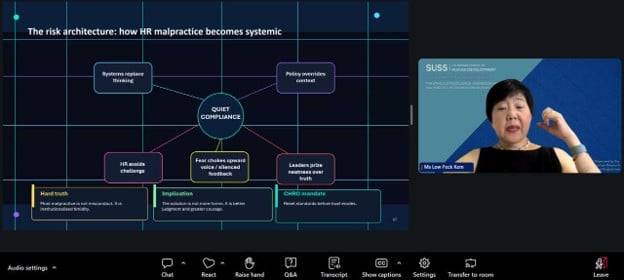
Another important theme was the difference between compliance and ethics. Many HR functions are measured by clear metrics such as speed, cost efficiency, and adherence to the Tripartite Guidelines, Advisories, and Standards. However, these do not necessarily reflect the ethical impact of HR decisions. The decisions behind who is hired, developed, or let go carry a significant impact on employees’ livelihoods and shape workplace culture. Ms Low explained that malpractice is not simply about breaking rules, but about failing “to do what is right, not just what is required.” This reframing shifts the focus from procedural correctness to moral accountability.
“HR malpractice is really not about bad people. It’s about whether HR is willing to be accountable for doing what is right, not just what is required.”— Ms Low Peck Kem
The discussion also highlighted key policy and governance issues. First, organisations must strengthen oversight of AI and build governance systems for automated HR decision-making. Not only to check that the technology works, but also to ensure that people remain accountable for decisions. Decisions supported by algorithms must be subject to scrutiny, with clear ownership assigned to human decision-makers. Without such safeguards, decisions may become less transparent and result in unjust outcomes.
Second, there is an urgent need to reclaim HR’s mandate as an independent ethical steward of an enterprise. This requires shifting away from viewing HR as an administrative function tasked with enforcing policy, and toward positioning it as a professional body capable of advising, challenging, and shaping organisational decision-making. Unlike fields such as law or medicine, HR does not have widely enforced standards or independent regulatory bodies. This makes it harder for HR professionals to challenge unethical decisions, especially when under pressure from senior leaders. Strengthening professional accreditation, ethical codes, and collective bodies can help provide support and raise standards across the field.
Third, there is a need to recalibrate how HR effectiveness is measured. The dominance of efficiency-based metrics encourages behaviour that prioritises process compliance over human-centred outcomes. Organisational evaluation systems should be balanced with indicators of trust, fairness, and employee experience. As highlighted in the discussion, retrenchment is not just about deciding who leaves, but how the process is carried out. While respectful and transparent retrenchment practices may take more time and effort, they help preserve employee dignity, maintain trust among remaining staff, and strengthen long-term organisational resilience.
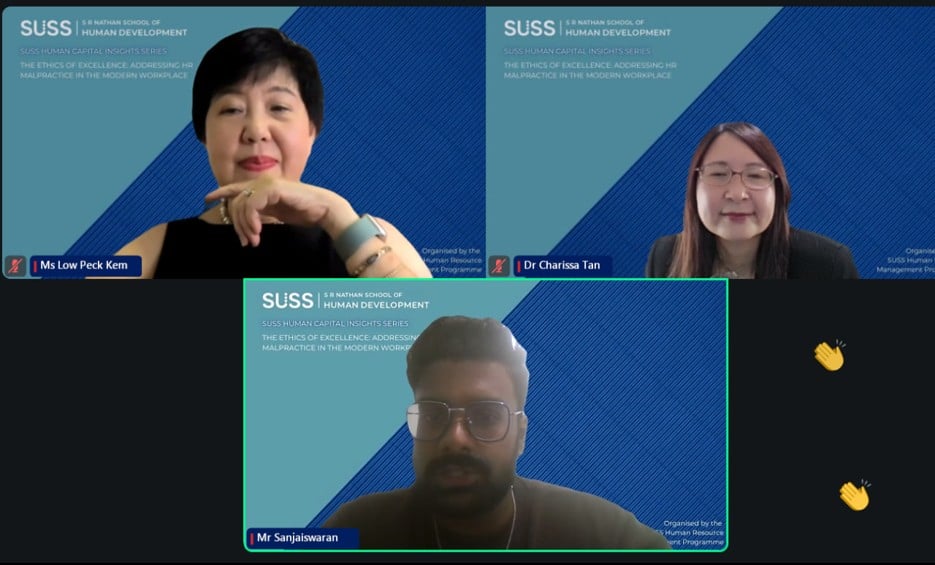
The Q&A discussion explored the practical challenges faced by HR practitioners operating within hierarchical organisations. In addressing these concerns, Ms Low emphasised that institutional support and accreditation systems — such as the Institute for Human Resource Professionals (IHRP) in Singapore and CIPD in the United Kingdom — can help strengthen professional standards and provide HR practitioners with a collective voice when facing pressure from senior leaders. Most importantly, HR practitioners must cultivate a strong moral compass and be willing to speak up when needed. Ms Low illustrated the principle of “high tech, yet high touch” with a personal story: returning to Singapore on her birthday, she passed through the automated immigration gantry at Changi Airport and was greeted not with the usual “welcome home”, but with a personalised “Happy Birthday” message and digital confetti on the screen. ICA had achieved this using data it already held, at virtually no additional cost. The moment, small as it was, left a lasting impression. As Ms Low reflected, this is precisely what HR must aim for — using technology not to strip away the human element, but to amplify it. Technological advancement can improve efficiency, but it must never replace the human responsibility to ensure employees feel cared for and respected.
“...for HR to hold itself to the same ethical accountability as the legal or medical professions is exactly the paradigm shift our industry needs.”— Dr Charissa Tan
Watch the Replay: You can watch the full recording of "Addressing HR Malpractice in the Modern Workplace: Insights" at https://youtu.be/x3VyXGqr5uU.
The SUSS Human Capital Insights series provides thought leadership on the key trends and strategic imperatives reshaping Asia's human capital landscape. The series is organised by the SUSS Human Resource Management Programme, which offers undergraduate and postgraduate degrees, from the Bachelor of Human Resource Management—Singapore's first and only full-time bachelor's degree in HRM offered by an Autonomous University—to the Master of Human Capital Management. Our programmes are designed to equip HR professionals with the applied industry knowledge and strategic acumen needed to lead, innovate, and thrive in the future economy.
Visit us at: www.suss.edu.sg/academics/schools-college/nshd/human-resource-management-cluster