1. What inspired you to pursue research in your field and how has it evolved over time?
My path into supply chain research started in the field, not the classroom. Early roles in industrial hygiene, chemical logistics, and regional supply chain planning showed me how fragile and human-dependent supply chains really are. One delayed shipment or one overlooked risk can ripple through entire operations. That practical grounding led me to a PhD in Operations Management at the University of Melbourne, where I began studying redundancy and resilience in complex systems, starting with hospital operations. Over the past decade, my focus has broadened from operational efficiency to humanitarian and social-impact contexts, including disaster relief, community care, and inclusive education, because I became convinced that supply chain thinking has as much to offer vulnerable populations as it does to corporations.
2. What is the focus of your research?
My work centres on building resilient, sustainable, and ethically evaluated supply chains, particularly in humanitarian and healthcare/community-care settings. Two of my recently published papers reflect this: one applies multi-criteria decision methods to help humanitarian agencies select suppliers under uncertainty, while the other uses machine learning to identify the factors that most affect humanitarian access during crises. A common misconception is that supply chain management is purely about logistics and cost-cutting. In humanitarian and care contexts, it's really about equity: getting the right resources to the right people, often under conditions of scarcity, urgency, and information gaps.
3. What excites you about your research?
I’m energised by the intersection of rigorous analytical methods and real-world social need. Applying deep learning to humanitarian access traditionally assessed manually and using multi-criteria methods for supplier selection shows how quantitative tools can translate into decisions that speed up relief delivery. This excitement is carrying into a working paper currently under review that proposes a strategic framework for sustainable procurement in humanitarian supply chains, extending this thinking to sourcing decisions that balance sustainability with urgency. In parallel, I’m developing an ongoing project on food insecurity and equity, building on our recent journal paper examining how relief beneficiaries’ satisfaction can be measured and compared across different scales. The aim is to ensure that food and aid distribution systems are designed around the people they serve, not just around efficiency metrics.

4. How do you see the practical implications of your research affecting your field or society at large?
My research is designed to be usable, not just publishable. The supplier evaluation frameworks I’ve developed have been shared and informed actual practice with organisations such as the UN World Food Programme, HELP Logistics, and World Vision International. My work on ageing-in-place logistics and integrated care has informed discussions in Singapore’s preventive health ecosystem, and my contribution to Singapore Standard SS 644 on medication supply and delivery demonstrates how academic research can directly shape national guidelines. I see my role as translating operations research into tools that practitioners, including humanitarian coordinators, healthcare administrators, and community organisations, can apply.
5. How does your research reflect SUSS’ mission in achieving social good?
This is where my work feels most aligned with who I am as an educator. As SBIZ Prison School Coordinator, I bring the same lean, resilience-focused thinking I apply to supply chains into correctional education, helping build pathways for incarcerated learners into higher education. This work was recently recognised with a Gold Award at eLFA 2025. My humanitarian logistics research, my pro bono consulting with The Food Bank Singapore and Elder Care Centres, and my involvement in flexible-work and inclusive-employment research all reflect the same conviction: that rigorous scholarship should serve people who are often overlooked by mainstream business research: the incarcerated, the elderly, disaster-affected communities, and vulnerable workers.

A/P Tay Huay Ling presenting on SUSS School of Business (SBIZ) Prison school project.
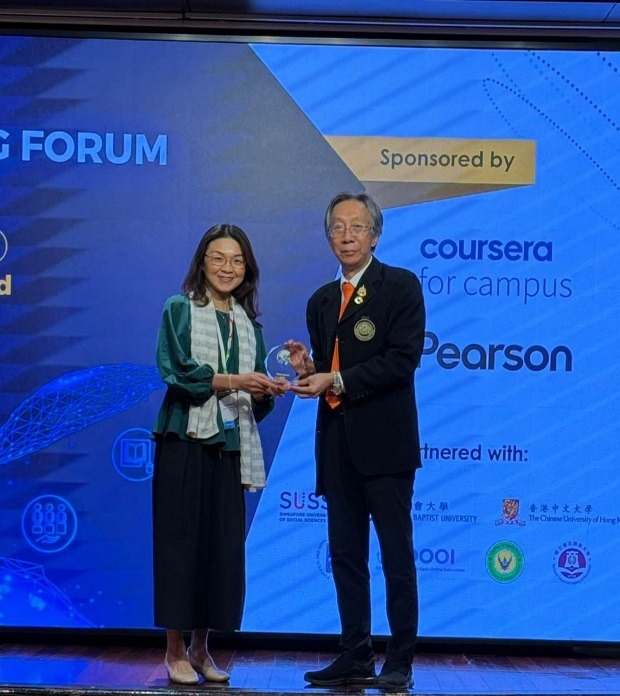
A/P Tay Huay Ling presented with the Gold Award in the Community Outreach Award category for the Prison School Project at the eLFA2025 Conference.

6. What are your future plans in your research?
I plan to deepen the integration of AI and data-driven methods into humanitarian and social-impact supply chains, building on my two recently published papers and my recent publication on AI in prison education. I’m also extending this work into sustainable procurement and food insecurity, recognising that food security and disaster resilience are closely linked. Longer-term, I hope to keep growing a body of work in socially engaged supply chain research, work that translates rigorous scholarship into real improvements for the communities it serves, both here in Singapore and internationally.
Published research by A/P Tay Huay Ling:
Recent publications mentioned above:
- Kay Khine, E.M., Tay, H.L. & Loh, H.S. Enhancing Resilience and Sustainability in Humanitarian Procurement: A Supplier Evaluation Framework Using the Best-Worst Method. Int J Disaster Risk Sci (2026). https://doi.org/10.1007/s13753-026-00757-3
- Guan, C., Tay, H.L., Zhao, Q. et al. Managing Humanitarian Access and Information Gaps: A Deep Learning Approach with MLP and Permutation Analysis. Int J Disaster Risk Sci (2026). https://doi.org/10.1007/s13753-026-00745-7
Others:
- Sim, M., Lee, V. A., Teo, K. W., Tay, H. L., Lertnimanoradee, M., Ong, B. C., Eu, E. & Foo, C. D. (2026). Safeguarding the bedrock of our healthcare system: recommendations to strengthen healthcare worker health in tertiary healthcare institutions. Frontiers in Public Health. https://doi.org/10.3389/fpubh.2026.1890465
- Banomyong R, Julagasigorn P, Tay HL, Varadejsatitwong P, Kusawat P (2026;), Linking relief service quality to beneficiaries’ satisfaction in humanitarian supply chains: an exploratory study using the HUMSERVPERF tool. Journal of Humanitarian Logistics and Supply Chain Management, Vol. ahead-of-print No. ahead-of-print. https://doi.org/10.1108/JHLSCM-08-2025-0148
- Xie, J.; Kim, K.; Woo, S.-H.; Lai, P.-L.; Tay, H. L. (2026). Global Logistics Performance and Crisis Management: Evidence from COVID-19. International Journal of Transportation and Logistics Research. https://doi.org/10.53941/ijtlr.2026.100004
- Karmakar, M.; Periyasami, K.; & Tay, H. L. (2026). Hybrid neuromorphic AI framework for energy-efficient and low-latency supply chain analytics. International Journal of Logistics Research and Applications. https://doi.org/10.1080/13675567.2026.2645705
- Tay, H. L.; & Foo, C. D. (2026). From response-to-routine: embedding humanitarian supply evaluation in Singapore’s health and community care systems. Frontiers in Health Services. https://doi.org/10.3389/frhs.2026.1761596
- Tay, H. L. (2026). AI in prison education: a call for ethical reflection. AI & Society. https://doi.org/10.1007/s00146-026-02944-8
- Tay, H. L. (2026). The Critical Role of Logistics for Ageing-in-Place: Insights from Active Ageing Initiatives. International Journal of Integrated Care. https://doi.org/10.5334/ijic.10176
- Tan, H. Y.; Loo, E. S.; Foo, C. D.; Tay, H. L.; Teo, K. W.; & Low, L. L. (2025). Operationalizing preventive care: the preventive health logistics ecosystem framework for aging societies. Frontiers in Public Health. https://doi.org/10.3389/fpubh.2025.1740511
- Banomyong, R.; Varadejsatitwong, P.; Julagasigorn, P.; & Tay, H. L. (2025). Developing a border performance index: Empirical evidence from Thailand. International Journal of Logistics Management. https://doi.org/10.1108/IJLM-02-2025-0116
- Tay, H. L.; Pepper, M.; & Tortorella, G. L. (2025). Lean Six Sigma for Value Creation in Non-Profit Organizations – A Volunteer Management Case Study. Public Organization Review. https://doi.org/10.1007/s11115-025-00890-5
- Tay, H. L., Loh, H. S., & Chen, H. S. (2025). Exploring humanitarian procurement: a systematic review. Cogent Business & Management, 12(1). https://doi.org/10.1080/23311975.2024.2445182
- Tay H. L. (2025). Enhancing Integrated Care Through the Voluntary and Community Sector: A Lean Management and Dynamic Capabilities Perspective. International journal of integrated care, 25(2), 13. https://doi.org/10.5334/ijic.9014
- Tay, H.L., Loh, H.S., Chen, H. and Gasper, N.L. (2025), “Enhancing resilience through strategic supplier selection and engagement for humanitarian organisations”, Continuity and Resilience Review, Vol. ahead-of-print No. ahead-of-print, pp. 1-16, doi: https://doi.org/10.1108/CRR-05-2024-0013