1. What inspired you to pursue research in your field, and how has your career/ research focus evolved over time?
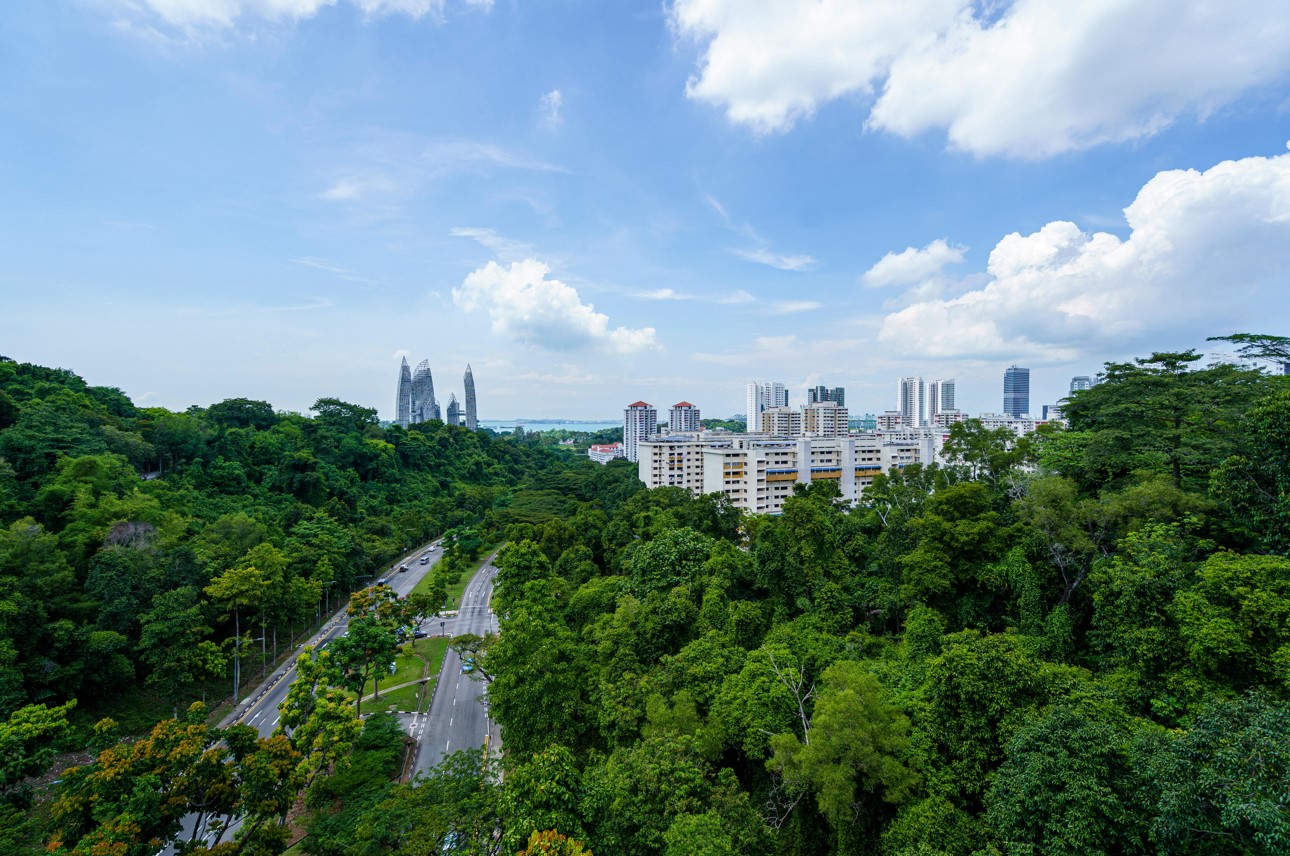
My current research centres on “Tree-Root Anchorage and Non-Destructive Tests for Trees in Constrained Urban Planting Spaces.” The project addresses a pressing and timely challenge - our limited understanding of how trees resist uprooting. With climate change intensifying, Singapore has faced increasingly severe storms and squalls, leading to a rise in tree failures. Gaining insight into how trees anchor themselves within dense urban environments is critical not only to prevent property damage and safeguard lives, but also to uphold Singapore’s enduring vision of being a Garden City.
At first glance, this topic may appear far removed from my original training in geotechnical engineering, where I specialised in unsaturated soil mechanics and advanced geotechnical testing. Yet, on closer look, the connection is natural. Tree uprooting often stems from a loss in soil strength, particularly when heavy rains saturate the ground and weaken root anchorage. This project is highly interdisciplinary, weaving together arboriculture, sensor technologies, and data acquisition systems, but at its core it remains deeply rooted in geotechnical principles.
My research journey has evolved with each stage of my career. During my time at NTU, I was immersed in “hard-core” geotechnical work, supported by laboratories and facilities. Returning to industry, my focus shifted towards numerical modelling which required less physical infrastructure but relied heavily on computing power. Now, back in academia, I face different constraints, such as limited space and facilities. But as the saying goes, “山不转,路转;路不转,人转” (If the mountain doesn’t turn, the road will; if the road doesn’t turn, we must). Adapting to these realities, I have embraced applied research and forged collaborations, such as this project with NTU’s Schools of CEE and EEE.

2. What is the focus of your research?
Trees in urban environments often face unique challenges. They are frequently forced to grow in highly constrained spaces, where infrastructure development may damage their roots. Increasingly, skyrise greenery has also become popular, with trees planted in shallow containers or thin layers of soil. These conditions limit healthy root development, leaving trees more vulnerable to uprooting during strong winds and storms—risks that are expected to intensify with climate change. My research seeks to better understand how urban trees anchor themselves in such environments and to develop non-destructive testing methods that can assess their stability, particularly in these constrained planting conditions.
3. What excites you about your research?
What excites me most is the potential for this research to shape industry practice. Our work can lead to the development of new test standards and guidelines for both destructive and non-destructive testing of trees. The equipment, data acquisition systems, and sensors we are developing can eventually be packaged for practical adoption by the industry. This is particularly meaningful for me because many of my students in the BBPM programme come from landscaping companies. To know that something we are developing at SUSS could directly benefit their work—and showcase how SUSS contributes technically to the industry—is deeply rewarding.


4. How do you see the practical implications of your research affecting your field or society at large?
The practical impact of my research lies in turning scientific insight into tangible tools and practices that can benefit both the industry and society. By developing reliable non-destructive testing methods and guidelines for assessing tree stability, we can help city planners, landscape managers, and contractors make informed decisions that reduce the risks of tree failures. This not only enhances public safety and protects infrastructure but also ensures that Singapore’s vision of a Garden City can be sustained in the face of climate change.
For the field of civil and environmental engineering, my research broadens the application of geotechnical principles into new domains, demonstrating how engineering competencies can address environmental and societal challenges beyond traditional construction. For society at large, the outcomes are equally significant: safer streets, greener spaces, and stronger resilience against climate impacts. In essence, the work bridges technical innovation with everyday wellbeing, showing how research can contribute directly to building a safer, healthier, and more sustainable urban future.
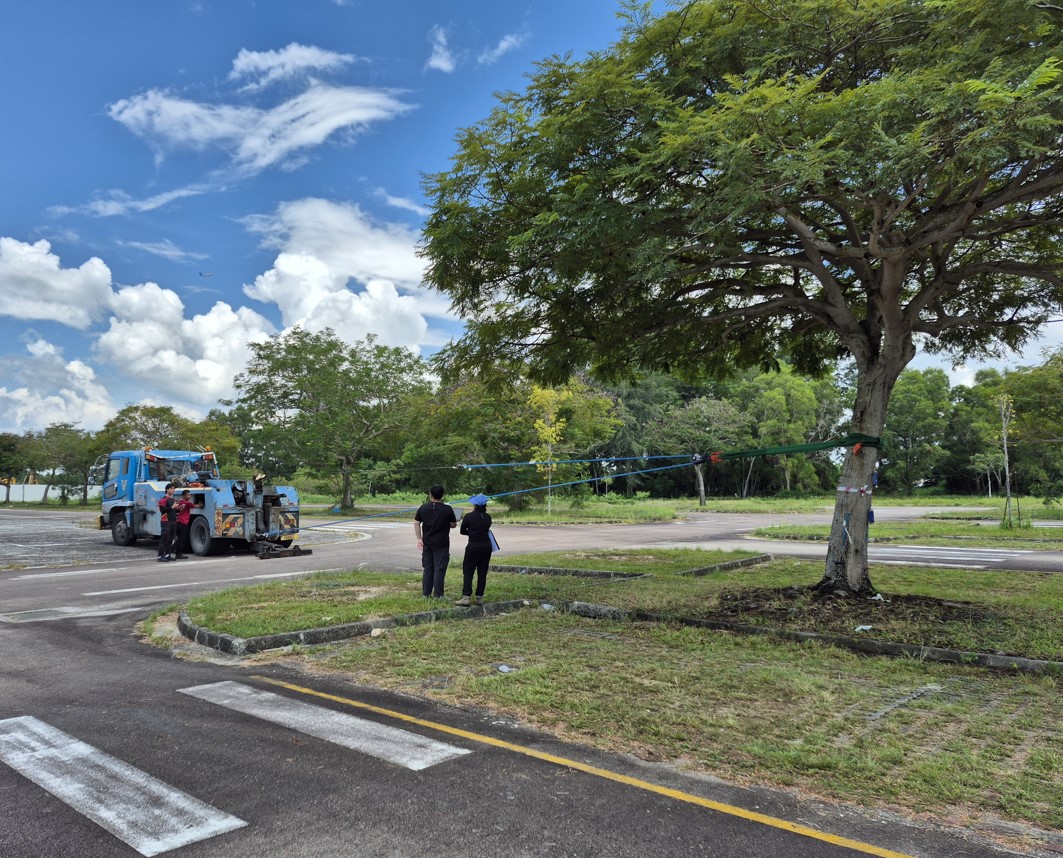 Image of Dr Cheng Zhuoyuan and his team at a site test.
5. How does your research reflect SUSS’ mission in achieving social good?
At its core, my research is about making our urban environment safer, greener, and more resilient by ensuring that trees continue to bring value to our city while protecting the community from risks such as uprooting during storms.
This aligns seamlessly with SUSS’s mission of driving impactful change for the social good and building a more equitable, sustainable society. It reflects the “softer side” of the built environment—where engineering meets environmental stewardship and community wellbeing. Personally, I feel that the ethos of SUSS has shaped my own research journey, inspiring me to take on projects that bridge engineering rigour with social and environmental impact.
6. What are your future plans in your research?
Looking ahead, much will depend on the priorities of funding agencies, but my aspiration is to refine and advance the technologies we are developing. In particular, I hope to perfect the sensors used in our site tests to make them truly wireless, more robust, and capable of delivering reliable data under real-world conditions. Achieving this would not only enhance the accuracy and efficiency of tree stability assessments, but also make the tools more practical and scalable for widespread industry adoption. Ultimately, I envision this research contributing to smarter, greener, and safer cities.