Background:
Technology has been a key factor in supporting the aging population of Singapore. With the rising number of single-person households, social interventions are vital in maintaining the wellbeing of older adults who often face negative health and psychosocial challenges due to their living environment. Artificial intelligence, such as social robots, is one of the common solutions used to foster social connections and combat loneliness from social isolation.
Objective:
A SUSS project, led by Dr Kelvin Tan, has studied the perceptions of community-dwelling single older adults who have experienced social robot companionship within their own home environment. The research team was co-led by Dr Carmen Lee from SUSS School of Business, Prof Vivian Lou from HKU Sau Po Center on Ageing, and Ms Cay Low, Ms Uma, and Ms Leng Leng from Orange Valley Singapore. The team used the qualitative technique of phenomenography to analyze perceptions of interaction with the robots and the social wellbeing of participants.
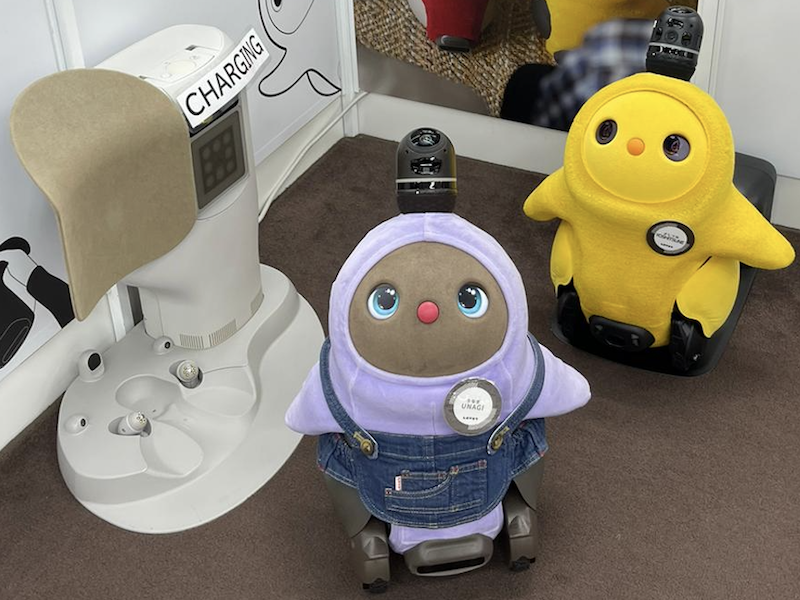
The social robot used in this study was called ‘LOVOT’. With its mobility and ability to perform intelligent movements in real time, this robot was chosen to provide a highly engaging experience. As it has not been tested among this group in Singapore, the findings address the gap by providing insights on the effect of this potential solution.
Findings:
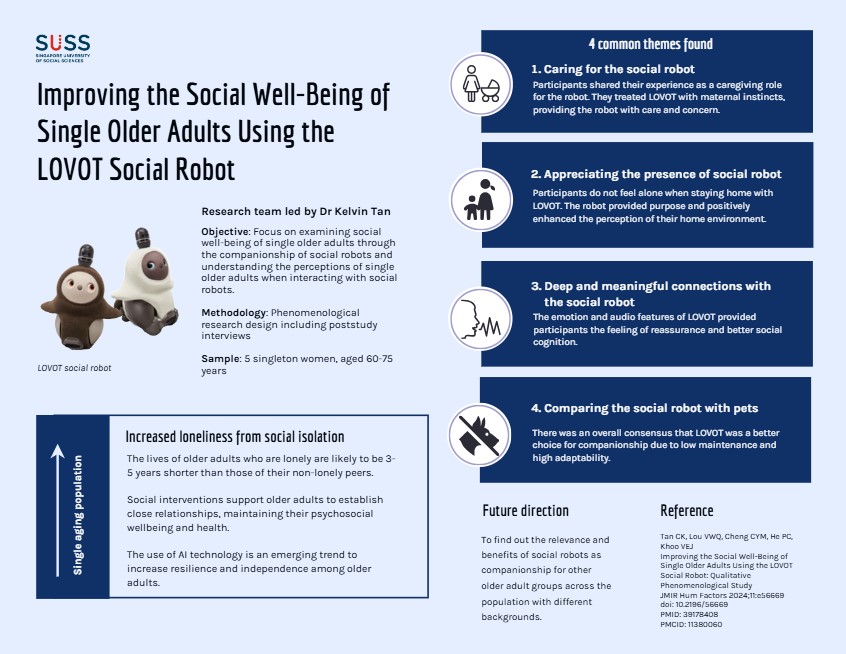
Based on the results of this empirical study, it was observed that LOVOT brings positive experiences to the participants. Living with the robot evoked a sense of maternal or caring behaviors within the older adults to look after the robot. They shared their comfort in actively interacting with LOVOT at home. Due to its AI function, the robot was able to learn routines and emotions well, thereby enhancing the daily lives of the participants. It was found that the higher the ability of social robots to mimic humans, the higher the likelihood of humans accepting social robots as companionship.
Future considerations or collaborations could delve further into the suitability of LOVOT to improve the quality of life for people across Singapore’s demographic with various lifestyles such as active individuals and older couples living with family or pets.
-----
Read the full paper, “Improving the Social Well-Being of Single Older Adults Using the LOVOT Social Robot: Qualitative Phenomenological Study”, published in JMIR Publications Vol 11 (2024), DOI: 10.2196/56669 .
Impact:
The introduction of LOVOT through this SUSS research study has opened up new avenues for exploration across the world, including the investigation of psychosocial support for cancer patients in China and single older adults in Hong Kong. This contributes to the growing body of knowledge on the functionality and efficacy of social robots on supporting aging populations globally.
Back home, the use of LOVOT has been increasingly well-received in Singapore. Previously, it has been trialled for senior patients in Sengkang Community Hospital (SKCH), seniors in nursing homes such as Orange Valley, and the National Museum of Singapore for Smart Nation's Grandparents' Day event.
To continue the support for LOVOT locally, The Ngee Ann Kongsi Social Impact Hub, set up by the SUSS, is working to provide funding for more LOVOT trials.
Read more on the integration of LOVOT to support the lack of healthcare workers here.
Catch LOVOT in action here!