Generative AI Resources
These resources have been curated to support teaching and learning excellence, and will be updated regularly.
This resource provides guides, explanations, and ideas to support SUSS faculty and associates in thoughtfully integrating Generative AI into their teaching practice – with a focus on pedagogy and student learning.
Generative AI (GAI) is a subset of AI that utilises machine learning models to create content, including text, images, or videos. Large Language Models (LLMs) are a modern type of generative AI that is used to understand and create text, powering tools such as Microsoft Copilot, ChatGPT, DeepSeek, Claude, Perplexity and Google Gemini.
Integrating GAI into teaching and learning at SUSS is a vital step towards enhancing the quality, efficiency, and inclusivity of the educational experience we provide.
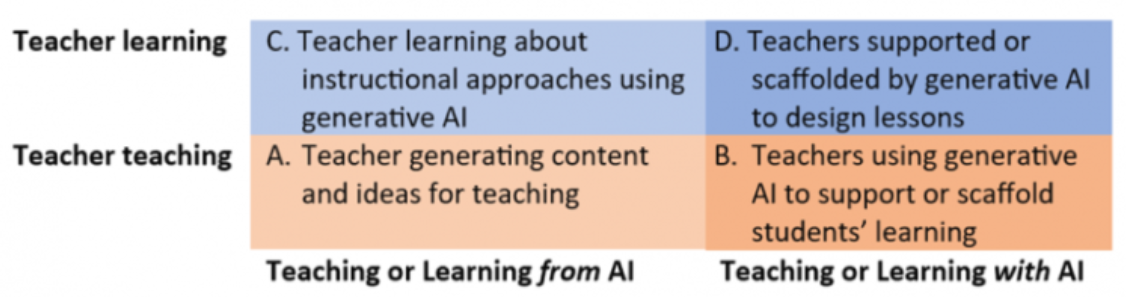
There are a few ways that GAI can benefit faculty (e.g., Tan, 2024). This is depicted in the diagram below from Tan (2024) and in the article where he provides illustrative examples.
Check out the link to the full article: https://singteach.nie.edu.sg/2024/04/29/navigating-the-future-of-education-perspectives-on-ai-integration/
One of the most common applications of generative AI is to support faculty in generating content and ideas for teaching. Rapid advancements in AI technologies have created exciting opportunities for faculty to transform traditional teaching methods and improve student engagement.
The links below provide ideas and suggestions of how to generate content and ideas for teaching with GAI:
- Harvard University – Teach with Generative AI
- Harvard University - Examples and Ideas for Using AI for Your Teaching
- Concordia University – Teaching with Generative AI
- University of Florida – Examples of AI Applications for Teaching and Learning
- Adv HE – AI in Classroom Teaching
GAI can be explored as a learning support tool, for example to:
- help students brainstorm ideas before writing,
- generate alternative explanations or perspectives,
- critique existing ideas,
- support reflection and metacognitive questioning
- provide instant feedback
- act as an on-demand tutor, thinking and dialogic partner
The greatest learning benefit comes when students engage critically with GAI's outputs rather than simply accepting them, turning each interaction into an opportunity for deeper understanding.
See TLC webpage on Supporting Student Learning with GAI
Faculty can use GAI to learn about AI or develop AI readiness. This means developing faculty’s knowledge about how AI works, what it can do and what it cannot do, and the ability to leverage AI for teaching and learning. Also critical is the understanding of ethical issues surrounding the use of AI for education. Faculty who engage with GAI as learners themselves are better positioned to guide students in using it responsibly and effectively.
The following resources offer practical guidance to support faculty in developing AI readiness for teaching and learning.
- AI Competency Framework for Teachers — UNESCO’s (2024) new competence framework aims to guide countries in supporting students and teachers to understand the potential as well as risks of AI in order to engage with it in a safe, ethical and responsible manner in education and beyond. It is designed to guide policy-makers, educators and curriculum developers in equipping students with the necessary skills, knowledge and values to engage with AI effectively.
- Guidance for Generative AI in Education and Research — UNESCO (2023): practical guidance for educators and institutions on the responsible use of generative AI.
- Bowen, J. A., & Watson, C. E. (2024). Teaching with AI: A practical guide to a new era of human learning. Johns Hopkins University Press - A widely cited book for educators navigating AI integration in teaching and learning.
Generative AI can also support faculty in their design of a lesson. A useful way to approach GAI is to start with teaching intent rather than tools. This means thinking pedagogically about GAI.
Helpful questions include:
- What do I want students to learn or practise?
- Where do students typically struggle or get stuck?
- Could GAI support learning and thinking processes rather than replace them?
Faculty commonly explore GAI for preparation work, such as:
- drafting slides, lesson materials and resources,
- brainstorming lesson activities or discussion questions,
- generating examples or short case scenarios,
- rephrasing explanations for different levels of learners,
- drafting formative practice questions or quizzes.
GAI outputs are treated by faculty as rough drafts rather than finished teaching materials. In this way, GAI acts as a thinking dialogic partner rather than an oracle.
Some useful tools for designing lessons include:
- AI Syllabus and Curricular Development Prompts for Instructors: Provides suggestions for prompts that can support curriculum design and syllabus composition.
- The Little Book of GAI Prompts for Teachers: Suggests prompts for the basic LLMs like ChatGPT
- FeedbackFruits ACAI: Beneficial for higher and adult education faculty because enables AI-driven feedback, personalised and peer feedback, allowing instructors to focus on personal student guidance as well as facilitates active learning.
- Eduaide.AI: While used in K-12, its "Instructional Design" mode is widely leveraged by adult educators. It focuses heavily on research-backed structural models (like the ADDIE model or Gagné's Nine Events of Instruction) to map comprehensive adult learning units.
- Curipod: Generates slides as well as interactive lessons including quizzes and polls from just a few inputs. Uses Backward Design to ensure your lesson aligns with your learning objectives.
- TeachmateAI: Over 50 tools in one product including a lesson plan writer, slideshow generator and text simplifier.
- MagicSchool AI: A comprehensive suite for lesson planning, differentiated instruction, and administrative automation.
- Brisk Teaching: Helps to turn a great article or video into an interactive classroom activity, generates classroom-ready materials, resources assessments, slide decks, podcasts, and more.
- SchoolAI: A generative AI platform built specifically for K-12 and higher education. It quickly generates lesson plans, rubrics, and quizzes, while offering interactive, teacher-monitored chat spaces where students can learn at their own pace.
- NotebookLM (Google): Enables you to quickly generate differentiated activities, study guides, and engaging multimedia materials all heavily grounded in your exact sources simply by uploading your specific curriculum, textbooks, and lesson materials. In so doing, you can bypass hours of manual resource creation.
- Canva Magic Studio: Used for creating visual teaching materials, presentations, and infographics.
- EduSageAI: Enables faculty to create tailored lesson plans and automatically adapt or scaffold reading levels and activities to suit various learning needs; build standards-aligned rubrics and rapidly produce customized worksheets, assignments, and graphic organizers that align with your teaching goals.
GAI can also be used to design formative and summative assessments. See TLC's webpage on Assessment with Generative AI
Faculty are referred to the links below for a further curated list of AI resources:
Chan, C. K. Y. (2023). A comprehensive AI policy education framework for university teaching and learning. International Journal of Educational Technology in Higher Education, 20, Article 38. https://doi.org/10.1186/s41239-023-00408-3
Dickey, E., & Bejarano, A. (2024). A framework for using Generative AI to assist in course content development. arXiv. https://arxiv.org/abs/2308.12276v4
Long, T. T., Lam, N. T., & Cuong, T. Q. (2025). AI integration into curriculum design and development: Theoretical framework and application. In S. Pal & Á. Rocha (Eds.). Lecture Notes in Networks and Systems, Vol 1399. Proceedings of 4th International Conference on Mathematical Modeling and Computational Science. ICMMCS 2025 (pp. 352-361). Springer. https://doi.org/10.1007/978-3-031-91005-0_32
Mikeladze, T., Meijer, P. C., & Verhoeff, R. P. (2024). A comprehensive exploration of artificial intelligence competence frameworks for educators: A critical review. European Journal of Education: Research, Development and Policy, 59(3). https://doi.org/10.1111/ejed.12663
Faculty who wishes to continue learning may explore:
- AI for Education – Webinars and Short Courses
- TeachAI – Educator Toolkit on Responsible AI Use
- Professional learning video series: In this series, Stanford faculty share their experiences and perspectives on AI and learning as they respond to questions from educators. Each video comes with a set of discussion questions that teachers can use to self-reflect or engage in conversation with colleagues.
The teaching redesign consultation is a mentoring session to support faculty and associates to plan for and/or integrate Generative AI in teaching.
Make an appointment – Online consultation
Please ensure you book an appointment at least three (3) working days in advance, and we will get back to you with the meeting invitation.
Consultant: Dr Stefanie Chye
Notes:
- Consultation sessions will be held every third Thursday of the month, between 2.30pm and 4.00pm (unless otherwise stated).
- Each consultation session lasts for 30 minutes, i.e., three sessions every month.
- Consultations will be conducted online via Zoom.
- Maximum of four (4) faculty and/or associates per session.
Click here to make a booking.