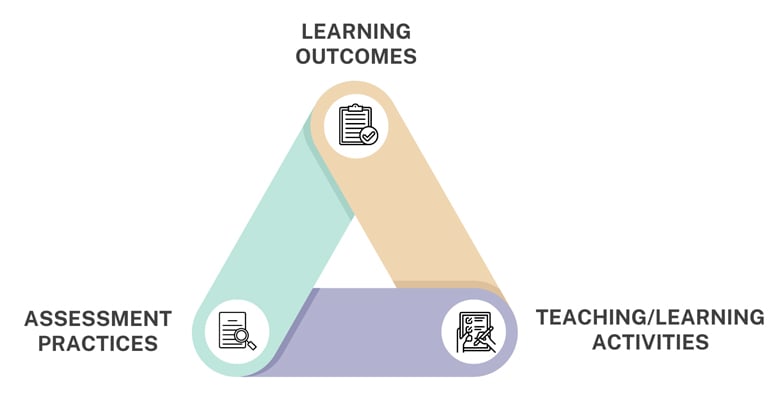
Assessment practices should be aligned to intended learning outcomes and teaching/learning activities (Biggs, 1999).
Assessment practices include various forms of activities that instructors use to gather information about the extent to which students have achieved the intended learning outcomes. Graded assessments are oftentimes used to sum up and evaluate students’ performance. Instructors can also use ungraded assessments to gauge students’ learning progress, which can help instructors and students take informed actions to improve teaching and learning to meet the learning outcomes (Brown & Knight, 2012).
Whether a task meets its intended purpose is a key consideration in all assessment practices. For example, using multiple-choice questions to check students’ understanding of a topic during teaching may meet the intended purpose of identifying and clarifying students' misconceptions in time. However, using a short multiple-choice test is inadequate, if the purpose is to measure students’ competency in solving a complex problem in the real-world setting.
TLC Sharing Sessions
Short Videos: Fit-for-Purpose Assessment Practices
Speaker: Mr Neo Wee Koon
Synopsis: In this video, Mr Neo Wee Koon discussed using formative assessment strategies in the ACC201 Financial Accounting course to effectively check student understanding and address potential misconceptions in a timely manner.
Date: 28 October 2025
Speaker: Dr Mia Lee
Synopsis: In this video, Dr Mia Lee shared the design of a group-based assessment (GBA) for the NCO201 Learn to Learn, Learn for Life course. This GBA integrates generative AI, prompts students to critically evaluate AI outputs, and encourages them to reflect on their own work.
Date: 28 October 2025
Speaker: Dr Sheryl Chua Hwee Chin
Synopsis: In this video, Dr Sheryl illustrated the rationale underlying the design and implementation of the PSS499 capstone project, with a particular focus on the staged assessment process.
Date: 3 Sept 2024
Professional Sharing on Assessments
Explore our professional sharing sessions focused on assessment strategies and practices.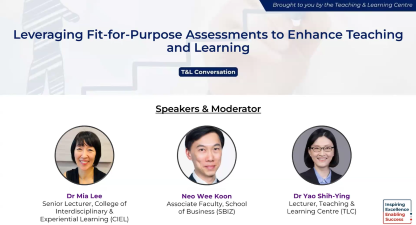
Leveraging Fit-for-Purpose Assessments to Enhance Teaching and Learning (28 October 2025)
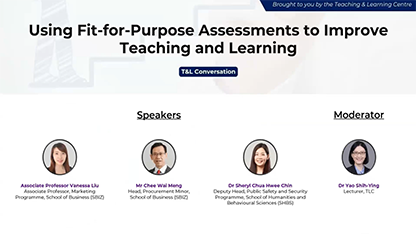
Using Fit-for-Purpose Assessments to Improve Teaching and Learning (3 Sept 2024)
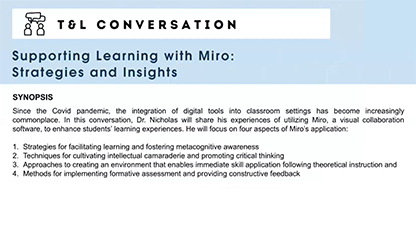
Supporting Learning with Miro: Strategies and Insights (29 Sep 2023)
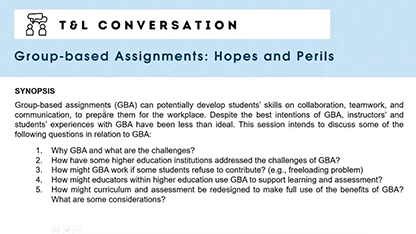
GBA: Hopes and Perils (23 March 2023)
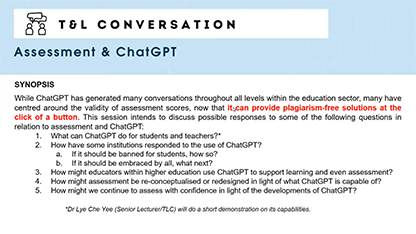
Assessment and ChatGPT (23 February 2023)
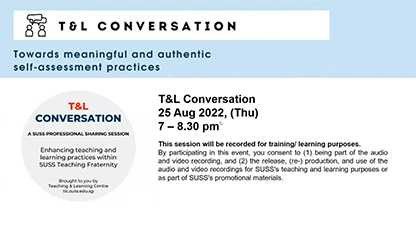
Towards Meaningful and Authentic Self-Assessment Practices (25 Aug 2022)
What Makes Feedback Helpful for Students (16 Jan 2021)
Further Readings
“Choosing and using fit-for-purpose assessment methods” guide by Heriot-Watt University.
"Choose the right assessment task" by Monash University.
References
Biggs, J. (1999). What the student does: Teaching for enhanced learning. Higher Education Research & Development, 18(1), 57-75. https://doi.org/10.1080/0729436990180105
Brown, S., & Knight, P. (2012). Assessing learners in higher education. Routledge.